
Predictive Maintenance in Energy Facilities: The Financial Impact of Unplanned Downtime in Hydroelectric Power Plants
- Introduction: Where Does the Real Cost of Unplanned Downtime Begin?
In energy production facilities, maintenance costs are often evaluated solely in terms of labor and spare parts expenses. However, the true cost begins the moment production stops. Particularly in continuously operating facilities such as hydroelectric power plants, a single critical equipment failure represents not only a technical issue but also a direct loss of revenue.
Unplanned downtime triggers a chain reaction of consequences, including production loss, emergency intervention expenses, disruption of operational schedules, and long-term equipment damage. For this reason, maintenance strategies must no longer be viewed merely as “repair activities,” but rather through the lens of risk and financial management.
Predictive Maintenance is a data-driven strategy that aims to detect potential failures before they occur by analyzing equipment data. In this article, the technical and financial impact of predictive maintenance in energy facilities will be examined quantitatively through the example of a 50 MW hydroelectric power plant.
TL;DR – Executive Summary
- The cost of unplanned downtime is often higher than the direct cost of maintenance itself.
- In hydroelectric power plants (HPPs), turbines, generators, and bearing systems represent critical risk points.
- In a 50 MW sample scenario, a single unplanned failure can result in an estimated cost of approximately 300,000 USD.
- With predictive maintenance, the same scenario can generate annual savings of approximately 212,000 USD.
- Digital predictive maintenance programs can accelerate ROI by turning technical signals into actionable operational and financial insights.
- How Does Predictive Maintenance Work?
Predictive Maintenance is a condition-based maintenance strategy that aims to intervene before a failure occurs by monitoring equipment behavior through real-time data. In traditional maintenance approaches, intervention takes place either after a failure has occurred (reactive maintenance) or at predetermined time intervals (preventive maintenance). Predictive maintenance, however, makes decisions based on the “actual health condition” of the equipment.
Maintenance strategies in the energy sector have undergone a significant transformation over the past two decades. Advances in data acquisition technologies, decreasing sensor costs, and the widespread adoption of digital platforms have made maintenance processes far more predictable [1]. This transformation provides a strategic advantage, particularly in energy facilities where production continuity is critical.
- Data Collection and Condition Monitoring
The first step of predictive maintenance is the continuous collection of data from equipment. This data is used to understand normal operating behavior and to detect deviations from expected performance patterns.
In energy facilities, the most commonly monitored parameters include:
- Vibration signals
- Temperature values
- Pressure and flow measurements
- Electrical parameters
- Oil analysis results
This process is referred to as “condition monitoring” [3]. The objective is to track equipment behavior over time and identify abnormal changes at an early stage.
- Data Analysis and Failure Detection
Raw data collected from equipment does not directly generate actionable decisions. It must first be analyzed and interpreted.
Vibration data is processed using frequency analysis and time–frequency methods. Through these techniques, the following types of failures can be detected at an early stage:
- Bearing wear
- Imbalance (balancing issues)
- Mechanical looseness
- Gear defects
For example, a bearing failure typically shows an increase at specific frequencies in the vibration spectrum weeks before the system actually stops operating. When these early signals are detected, the failure has not yet caused production downtime, allowing maintenance teams to intervene proactively.
|
Technical Note: RUL (Remaining Useful Life) Remaining Useful Life (RUL) is a modeling approach that aims to estimate how much operational time remains before a piece of equipment fails. Evaluated within the framework of Prognostics and Health Management (PHM), this method enables the optimization of maintenance scheduling [1]. The objective is to provide a data-driven answer to the question: “When will the equipment fail?” |
- Decision Support and Asset Management Integration
Predictive maintenance is not merely about generating failure signals. Its real value lies in integrating these signals into operational and financial decision-making processes.
The ISO 55000 standard states that maintenance decisions should be aligned with the overall asset management strategy [4]. For this reason, in modern energy facilities, technical data is analyzed together with:
- Financial indicators
- Operational plans
- Risk assessments
In practice, the process typically follows this sequence:
Data → Analysis → Risk Score → Intervention Recommendation → Work Order
Through this chain, maintenance ceases to be purely a technical activity and becomes an integral part of the corporate decision-making mechanism.
- The Impact of Predictive Maintenance in Energy Facilities
In energy production facilities, failures are not merely technical problems. Particularly in continuously operating facilities such as hydroelectric power plants (HPPs), a single critical equipment failure can affect the entire production chain.
In the power generation sector, failures are generally low in frequency but high in cost when they occur [1]. Therefore, the maintenance strategy is not only an engineering decision but also a strategic choice that directly influences financial performance.
Figure 1: P–F Curve and the Intervention Time Window
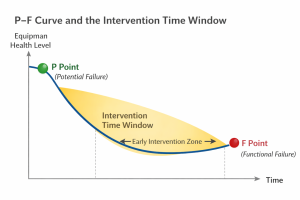
(The time between potential failure and functional failure represents the critical opportunity window for planned intervention.)
- Technical Impact: Critical Equipment Risk
In a hydroelectric power plant (HPP), production continuity depends on the following critical equipment:
- Turbine
- Generator
- Bearing systems
- Cooling circuits
- Lubrication systems
Mechanical wear or vibration-induced degradation in any of these components typically leads to cascading damage.
For example, a bearing failure that is not detected at an early stage may progress as follows:
Bearing → Shaft → Rotor → Generator
This progression can ultimately result in significantly higher repair costs and extended downtime.
|
Risk Card: Most Critical Failure Sources in Hydroelectric Power Plants
These failures generate minor signals at an early stage; however, if no intervention is made, they may eventually lead to unplanned downtime. |
Condition monitoring studies indicate that such failures can be identified at an early stage through vibration spectrum analysis [3]. Therefore, detecting the P point early on the P–F curve prevents the escalation of technical damage and mitigates the overall impact on the system.
- Operational Impact: The Chain Consequences of Unplanned Downtime
An unplanned shutdown does not only stop production. It also leads to:
- Rescheduling of the production program
- Potential grid balancing costs
- Redirection of maintenance teams to emergency response
- Expedited spare parts procurement
- Reallocation of internal operational resources
This situation differs significantly from planned maintenance outages. Planned shutdowns are controlled and scheduled, whereas unplanned downtime creates operational uncertainty.
The predictive maintenance approach aims to increase production continuity and minimize unplanned downtime [1].
- Financial Impact: Production Loss and Indirect Costs
The cost of unplanned downtime in an energy facility can generally be grouped into three main categories:
- Direct production loss
- Emergency maintenance and labor expenses
- Long-term equipment damage risk
Production loss is typically calculated using the following formula:
Production Loss =
Installed Capacity × Capacity Factor × Downtime Duration × Electricity Price
This simple formula makes the financial impact of maintenance decisions clearly visible. The literature emphasizes that maintenance strategies should be evaluated not only with technical data but also in conjunction with financial performance indicators [1][4].
Figure 2: Unplanned vs. Planned Downtime Cost Comparison
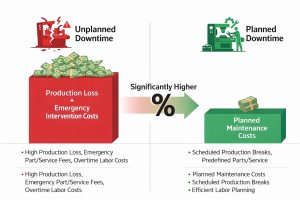
(In unplanned downtime, production loss and emergency intervention costs are significantly higher compared to planned maintenance.)
- Sample Scenario: Financial Impact Analysis of a 50 MW Hydroelectric Power Plant
To clearly demonstrate the value of predictive maintenance, it is necessary to analyze a concrete scenario. In this section, the financial impact of unplanned downtime is evaluated based on a hydroelectric power plant (HPP) with an installed capacity of 50 MW.
- Scenario Assumptions
The key assumptions used in the analysis are as follows:
- Installed Capacity: 50 MW
- Capacity Factor: 50%
- Electricity Sales Price: 80 USD/MWh
- Unplanned Downtime Duration: 5 days
- Annual Number of Unplanned Failures: 1
These values provide a realistic framework for a medium-scale hydroelectric power plant.
- The Real Cost of Unplanned Downtime
First, the average daily production is calculated:
50 MW × 24 hours × 0.50 = 600 MWh/day
For a 5-day unplanned outage, the total production loss becomes:
600 × 5 = 3,000 MWh
The financial equivalent of this loss is:
3,000 MWh × 80 USD = 240,000 USD
This figure represents only the lost sales revenue. When emergency maintenance, labor, spare parts, and operational costs are included, the total loss can reach approximately:
300,000 USD
The critical point here is the following:
In many cases, this loss exceeds the cost of replacing the equipment itself.
- The Same Scenario with Predictive Maintenance
Now, assume that the same failure is detected at an early stage, at the P point.
In this case:
- Instead of a 5-day unplanned outage
- A controlled 1-day planned intervention can be performed
The new production loss would be:
600 MWh × 1 day = 600 MWh
600 × 80 USD = 48,000 USD
Planned maintenance intervention cost (labor + parts):
≈ 40,000 USD
Total cost:
≈ 88,000 USD
- Annual Savings and ROI
When the two scenarios are compared:
Unplanned Scenario: 300,000 USD
Predictive Scenario: 88,000 USD
Annual difference:
212,000 USD in savings
Now consider the investment side.
Assume the facility invests in:
- Vibration sensors
- Data acquisition infrastructure
- Analysis software
- Training
Total investment: 120,000 USD
ROI calculation:
ROI = (212,000 − 120,000) / 120,000
ROI ≈ 77%
Payback period:
120,000 / 212,000 ≈ 7 months
These results demonstrate that predictive maintenance is not only a technical improvement but also a financially rational investment decision.
| Cost Item | Unplanned Scenario | Predictive Scenario |
| Production Loss | 240,000 USD | 48,000 USD |
| Maintenance Cost | 60,000 USD | 40,000 USD |
| Total Cost | 300,000 USD | 88,000 USD |
| Annual Savings | – | 212,000 USD |
| ROI | – | 77% |
| Payback Period | – | 7 Mon |
(Cost difference and payback period between the unplanned and predictive maintenance scenarios.)
- Analytical Evaluation
In the energy sector, failures are typically rare but high in cost. For this reason, early failure detection is not merely a maintenance strategy but a revenue protection mechanism.
This scenario demonstrates that:
- Production continuity is directly linked to revenue continuity
- Unplanned downtime represents a financial risk
- A data-driven maintenance approach can accelerate return on investment
- Digital Predictive Maintenance Infrastructure: Implementation Approach
Implementing predictive maintenance in a hydroelectric power plant requires more than simply installing sensors. The real value emerges when data collection, analysis, decision support, and execution processes operate in an integrated manner.
This section explains the technical components of a data-driven maintenance approach.
- Data Acquisition Layer
The fundamental input of predictive maintenance is measurable condition data.
Typical monitoring parameters in hydroelectric power plants include:
- Vibration data (bearings, shaft alignment, imbalance)
- Temperature measurements (bearings, generator windings)
- Oil analysis data
- Electrical parameters (current, voltage, harmonics)
- SCADA operational data
These data are collected via sensors and existing measurement infrastructure and transferred to a centralized data platform.
Key point:
Most power plants already have data; the challenge lies in interpreting it effectively.
- Data Analysis and Anomaly Detection
Collected data can generally be analyzed using two main approaches:
- Rule-based threshold analysis
- Machine learning and statistical modeling
Machine learning methods are particularly effective for:
- Anomaly detection
- Trend analysis
- Failure probability estimation
- Remaining Useful Life (RUL) prediction
At this stage, the system learns the “normal behavior profile” of the equipment and detects deviations at an early stage.
- Decision Support and Planning
Early warning alone is not sufficient.
The system must provide answers to the following questions:
- When should the intervention be performed?
- Can it be integrated with a planned outage?
- Are spare parts available?
- Is the intervention financially optimized?
At this point, integration between maintenance data and financial data becomes critical.
This integration ensures that the maintenance strategy is optimized not only technically but also economically.
- Integration with Asset Management
In the modern approach, predictive maintenance is not merely technical monitoring; it is also part of corporate asset management.
This approach:
- Aligns with ISO 55000 asset management principles
- Supports risk-based decision-making
- Enables life-cycle cost optimization
Maintenance decisions are no longer based solely on the question,
“Has the equipment failed?”
but rather on:
“How can the life-cycle cost of this asset be optimized?”
- Implementation Maturity Levels
Predictive maintenance systems typically evolve through four stages:
- Reactive (post-failure intervention)
- Planned / Preventive maintenance
- Condition-based maintenance
- Fully integrated predictive and prescriptive system
As the maturity level increases:
- The rate of unplanned downtime decreases
- The maintenance budget becomes more predictable
- Financial risk declines
- Evaluation
This approach demonstrates that:
- Installing sensors is not the solution by itself
• Data analysis alone is not sufficient
• The real value lies in integration
Predictive maintenance requires an integrated system in which technical, operational, and financial processes work together.
- Conclusion and Strategic Evaluation
In energy production facilities, maintenance strategies are not merely technical operational matters; they represent a critical management domain that directly affects financial performance. Particularly in hydroelectric power plants, unplanned downtime creates significant economic risk due to production loss, emergency intervention costs, and operational uncertainty.
The analysis conducted in this study demonstrates that:
- Unplanned failures are rare but high in cost
- Production continuity is directly linked to revenue continuity
- Early failure detection functions as a financial risk mitigation mechanism
The calculations based on the 50 MW sample scenario reveal that predictive maintenance is not only a technical improvement but also a high-return financial decision. An estimated ROI of approximately 77% and a payback period of 7 months support the economic feasibility of a data-driven maintenance approach.
However, the success of predictive maintenance cannot be achieved solely through sensor investment. Effective implementation requires:
- Reliable data acquisition infrastructure
- Analytical modeling capabilities
- Integration of maintenance and financial data
- Alignment with asset management principles
When evaluated within the ISO 55000 framework, it is recommended that maintenance strategies be designed to align with corporate objectives, support risk-based decision-making, and optimize life-cycle costs.
In the future, competitive advantage in the energy sector will be determined not only by production capacity but also by how efficiently, predictably, and data-driven assets are managed. In this context, predictive maintenance positions itself as a fundamental component of operational sustainability.