SCADA Security in Critical Infrastructure
Attack Surface Analysis and Defense Layers
Renewasoft | 2026
Level: Advanced Target Audience: SCADA Engineer, HPP Operator, CTO, Infrastructure Investor
Introduction: The Invisible Threat Behind the Turbine
Every 39 seconds, a cyberattack targets an internet-connected system somewhere in the world[1]. For most industries, a breach means data loss or financial damage. For a Hydroelectric Power Plant (HPP), a single compromised Programmable Logic Controller (PLC) can mean uncontrolled gate operations, turbine overspeed events, or cascading failures across an interconnected grid. The consequences are not abstract — they are kinetic, environmental, and potentially catastrophic.
Yet the operational technology (OT) environments that govern these assets were designed decades ago under a fundamentally different threat model: physical isolation. The Modbus RTU protocol, still the backbone of many HPP SCADA systems, was standardized in 1979[6]. It carries no authentication, no encryption, and no integrity checking.
That world no longer exists. The convergence of IT and OT networks has dissolved the air gap that once served as the primary defense. According to Dragos’s 2023 OT Cybersecurity Year in Review, threat groups targeting industrial control systems (ICS) increased by 35% year-over-year, with the energy sector remaining the most targeted vertical[2].
This post maps the attack surfaces unique to hydropower SCADA environments against established frameworks (Purdue Model[3], MITRE ATT&CK for ICS[4], IEC 62443[8]), and details how Renewasoft’s System platform addresses each layer of risk through AI-driven anomaly detection, adaptive network segmentation, and a Zero Trust security architecture[7] purpose-built for HPP operations.
System is not merely a cybersecurity solution — it is an end-to-end digital energy management platform that collects real-time data from SCADA and IoT sensors to deliver production forecasts, predictive maintenance scenarios, water flow predictions, and EPIİAŞ market integration. Cybersecurity is a critical component of this integrated platform; however, System’s added value lies in unifying security with operational intelligence within a single decision-support infrastructure[13].
► https://renewasoft.com.tr/index.php/tr/hizmetimiz/
Concepts 101: Key Terminology
For readers outside the SCADA/ICS domain, the following terms are foundational to understanding this post:
| Term | Definition |
|---|---|
| PLC | Programmable Logic Controller — a ruggedized industrial computer that controls physical processes (e.g., opening/closing a turbine wicket gate) based on programmed logic. |
| RTU | Remote Terminal Unit — a field device that collects telemetry from distributed sensors and transmits it to the SCADA system. |
| HMI | Human-Machine Interface — the graphical workstation screen operators use to monitor and control the plant in real time. |
| SCADA | Supervisory Control and Data Acquisition — the centralized system that collects data from PLCs/RTUs and provides supervisory control. |
| OPC UA | Open Platform Communications Unified Architecture — the de facto standard protocol for IT/OT data exchange. |
| DPI | Deep Packet Inspection — a network security technique that examines full packet payload, enabling protocol-aware filtering. |
| GOOSE | Generic Object Oriented Substation Event — IEC 61850 protocol for fast multicast communication between protection relays. |
Table 1: Key Terminology for OT/ICS Cybersecurity in Hydropower
TL;DR — Executive Summary
- IT/OT convergence has eliminated the air gap that historically protected HPP SCADA systems, exposing PLCs, RTUs, and HMIs to network-borne threats that legacy architectures were never designed to handle[2][3].
- Attack surface mapping reveals five critical weak points in typical HPP deployments: legacy serial protocols (Modbus, DNP3), unmonitored engineering workstations, flat network topologies, exposed OPC UA endpoints, and insufficient logging at Purdue Levels 0-2[4].
- Zero Trust applied to OT is not optional — it is operational necessity. The “Never Trust, Always Verify” principle must extend below the enterprise boundary to the process control network[7].
- A structured risk scoring model (R = T x V x I) enables HPP operators to prioritize remediation based on quantifiable, site-specific data rather than generic checklists[9].
- Data-driven security approaches can significantly reduce detection time by correlating OT network traffic with process-level signals, enabling faster and more accurate operational decisions.
The Paradigm Shift in SCADA and OT Security
The Purdue Model: A Framework Under Pressure
The Purdue Enterprise Reference Architecture (PERA), formalized by Theodore Williams at Purdue University in the 1990s[3], established the hierarchical model that still governs industrial network segmentation. Its six levels — from Level 0 (Physical Process) through Level 5 (Enterprise Network) — provide a logical separation between the physical world of sensors/actuators and the digital world of business applications.
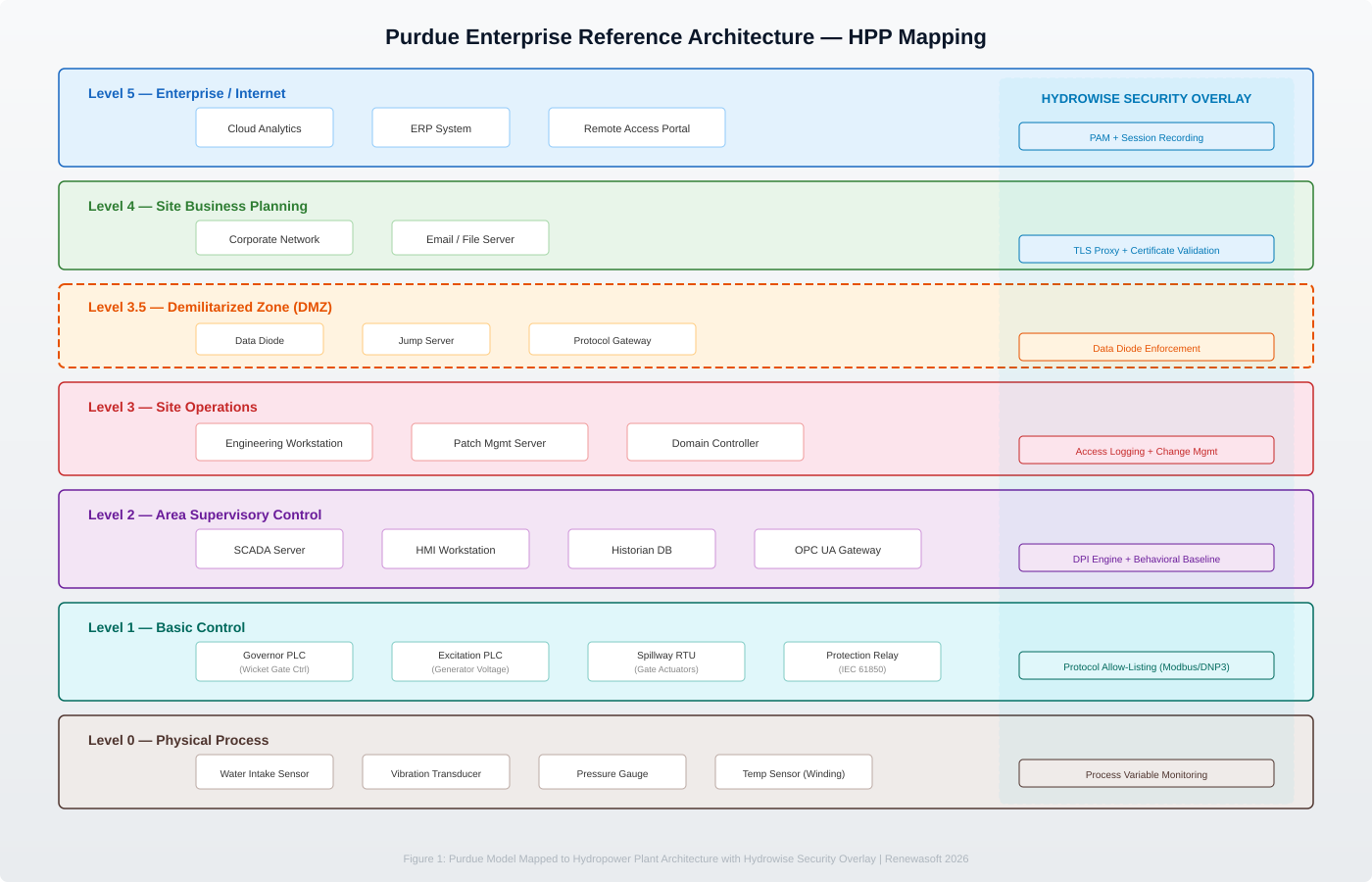
Figure 1: Purdue Enterprise Reference Architecture — HPP Mapping with System Security Overlay
🔍 Technical Note: Purdue Levels in HPP Context
Level 0 (Physical): Water intake sensors, vibration transducers, penstock pressure gauges, generator winding temperature sensors.
Level 1 (Basic Control): PLCs governing governor systems (wicket gate position), excitation systems, spillway gate actuators; RTUs aggregating distributed telemetry.
Level 2 (Supervisory): SCADA servers, HMI workstations, historian databases recording flow rates, head levels, power output, bearing temperatures.
Level 3 (Site Ops): Engineering workstations (Siemens TIA Portal, Rockwell Studio 5000), patch management servers, local domain controllers.
Level 3.5 (DMZ): Data diodes, jump servers, protocol-breaking gateways separating OT from IT.
Level 4/5 (Enterprise): Corporate ERP systems, cloud analytics platforms, remote access portals.
(Source: [3])
| Purdue Level | HPP Assets & Functions |
|---|---|
| Level 0 — Physical | Water intake sensors, turbine vibration transducers, penstock pressure gauges, generator winding temperature sensors |
| Level 1 — Basic Control | PLCs governing governor systems (wicket gate position), excitation systems, spillway gate actuators; RTUs aggregating distributed telemetry |
| Level 2 — Supervisory | SCADA servers, HMI workstations, historian databases recording flow rates, head levels, power output, bearing temperatures |
| Level 3 — Site Ops | Engineering workstations (Siemens TIA Portal, Rockwell Studio 5000), patch management servers, domain controllers |
| Level 3.5 — DMZ | Data diodes, jump servers, protocol-breaking gateways separating OT from IT |
| Level 4/5 — Enterprise | Corporate ERP, cloud analytics, remote access portals |
Table 2: Purdue Model Levels Mapped to HPP Assets [3]
The Modern Threat Landscape
The dissolution of Purdue’s hierarchical boundaries has coincided with a significant escalation in OT-targeted threat activity. The MITRE ATT&CK for ICS framework documents 12 tactical categories and over 80 techniques specifically applicable to industrial control systems[4].
| Threat Group | Capability | HPP Relevance |
|---|---|---|
| CHERNOVITE (Pipedream) | Modular ICS attack framework; Modbus TCP/IP, OPC UA, CODESYS PLCs [5] | Directly applicable to HPP protocol stack |
| ELECTRUM (Industroyer) | Manipulates IEC 61850 and IEC 104 to trip circuit breakers [5] | HPP grid interconnection and substation automation |
| XENOTIME (TRITON) | Targets Safety Instrumented Systems (SIS) [5] | Proves willingness to compromise last-line safety defense |
Table 3: ICS Threat Groups Relevant to HPP Operations [4][5]
Attack Surface Mapping: Where HPPs Are Most Vulnerable
A systematic attack surface analysis of a representative HPP SCADA environment — based on common deployment patterns across 10-500 MW plants — reveals five primary categories of exposure[4][8].
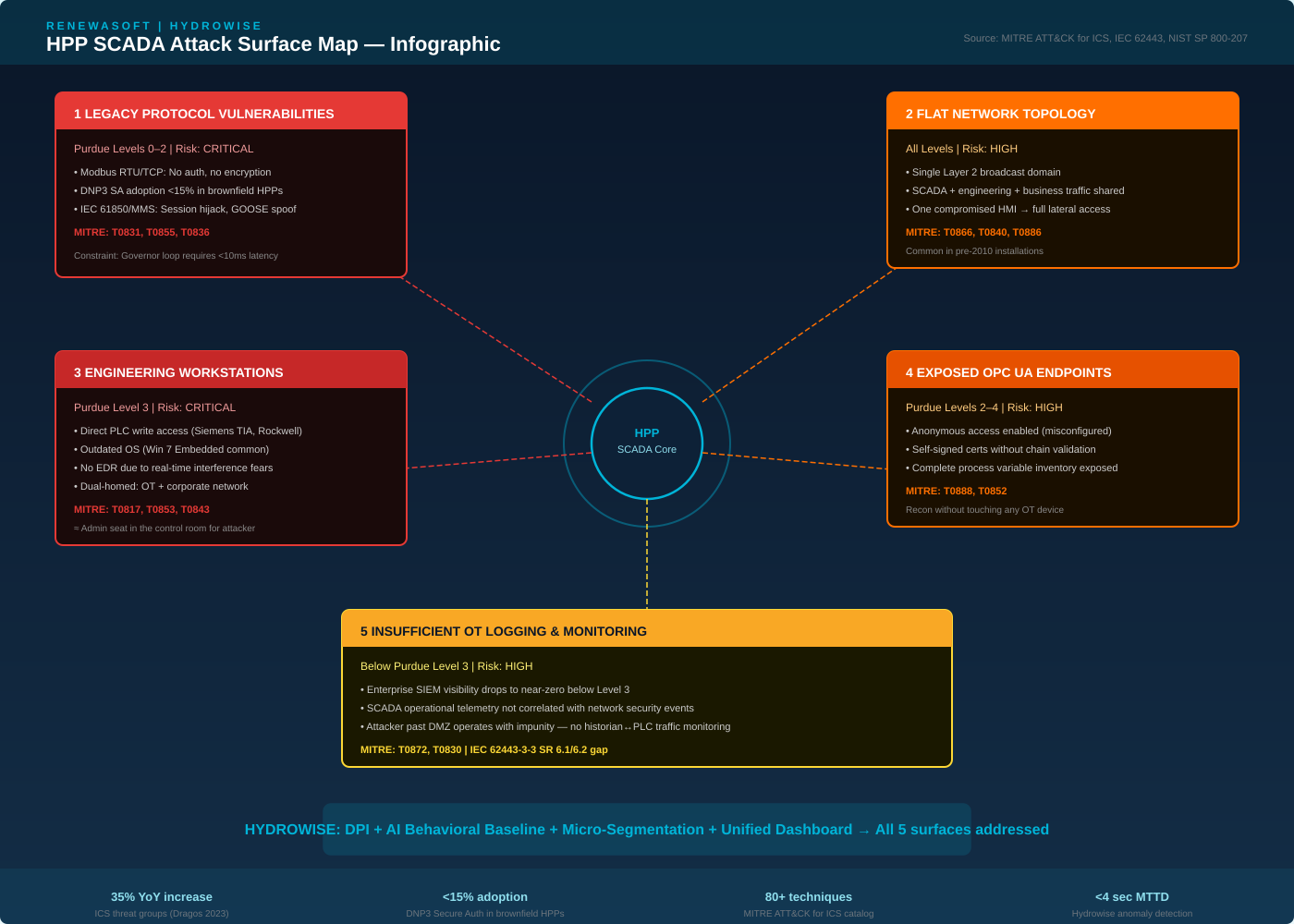
Infographic 1: HPP SCADA Attack Surface Map — Five Critical Exposure Categories [4][8]
| # | Attack Vector | Description | Risk Level |
|---|---|---|---|
| 1 | Legacy Protocols | Modbus RTU/TCP (no auth/encryption) [6], DNP3 SA adoption <15% [6], IEC 61850/MMS session hijacking | CRITICAL |
| 2 | Flat Network | Layer 2 broadcast domain shared: SCADA + engineering + business traffic | HIGH |
| 3 | Engineering Workstations | Direct PLC write access, outdated OS, no EDR, dual-homed to OT/corporate | CRITICAL |
| 4 | Exposed OPC UA | Misconfigured anonymous access; full process variable recon from IT network | HIGH |
| 5 | Insufficient OT Logging | Near-zero SIEM visibility below Level 3; no SCADA/security correlation [8] | HIGH |
Table 4: HPP Attack Surface Classification [4][6][8]
⚠ Risk Box: Engineering Workstation Compromise Path
Attack Vector: Spear-phishing email -> IT endpoint compromise -> RDP to EWS on OT network (Purdue Level 3 misconfiguration).
Impact: A compromised EWS provides direct PLC write access — functionally equivalent to an attacker in the control room with admin privileges.
MITRE Mapping: T0817 (Drive-by Compromise), T0853 (Scripting), T0843 (Program Download)[4].
Critical Factors: Outdated OS (Win 7 Embedded), no EDR, dual-homed network, PLC programming tools (Siemens TIA Portal, Rockwell Studio 5000).
Example mitigation approach: PAM enforcement eliminates direct RDP; behavioral baseline detects new scan patterns from EWS; DPI flags unauthorized PLC write commands[13].
(Source: [4][5][13])
Defense Layers and Zero Trust in OT Environments
The Zero Trust Imperative
Zero Trust Architecture (ZTA), as defined in NIST Special Publication 800-207[7], operates on the principle that no network location, user identity, or device should be implicitly trusted. Extending Zero Trust to OT requires adaptation — PLCs do not support modern identity protocols, and control loops cannot tolerate per-packet authentication latency.
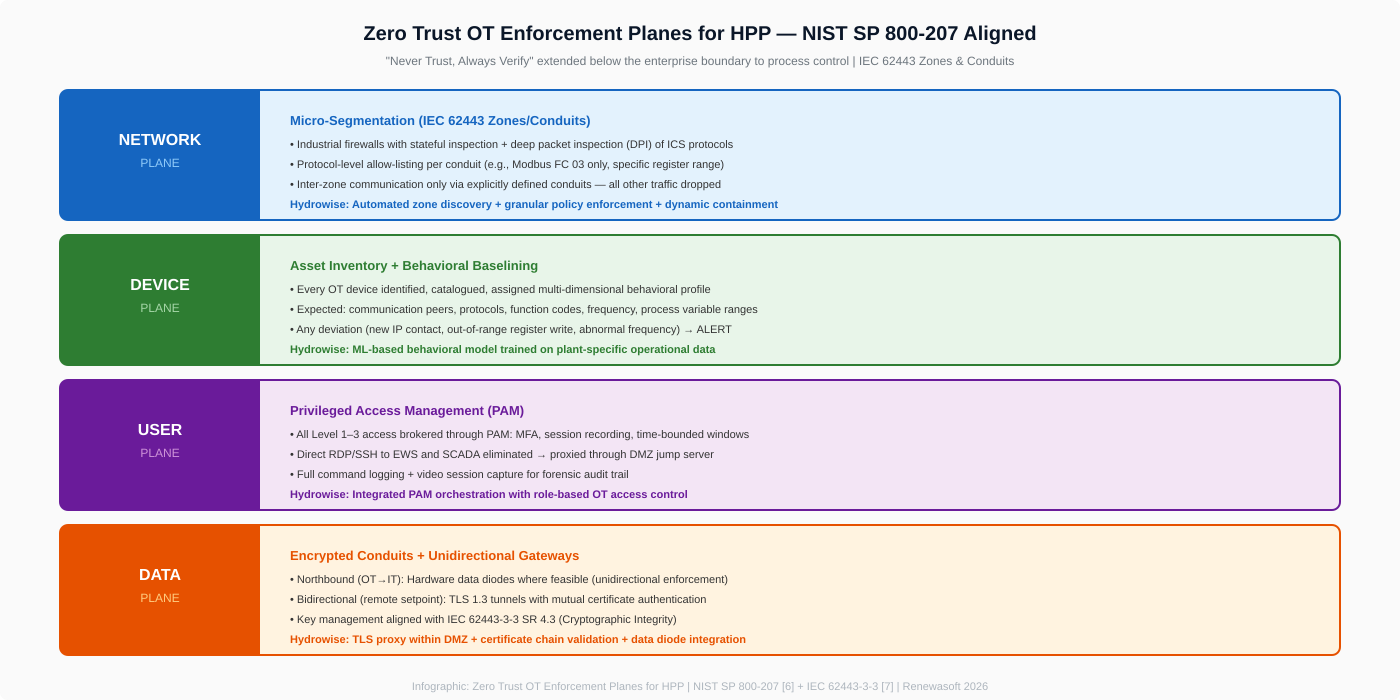
Infographic 2: Zero Trust OT Enforcement Planes for HPP — NIST SP 800-207 Aligned [7][8]
► NIST SP 800-207 Zero Trust Architecture → https://csrc.nist.gov/pubs/sp/800/207/final
► MITRE ATT&CK for ICS → https://attack.mitre.org/techniques/ics/
| Enforcement Plane | Implementation |
|---|---|
| Network Plane | Micro-segmentation into IEC 62443 zones/conduits [8]. DPI with protocol-level allow-listing. Example: Governor PLC may send Modbus FC 03 to SCADA on specific register range — any other FC/register/direction dropped. |
| Device Plane | Every OT device identified, catalogued, assigned behavioral profile: peers, protocols, function codes, frequency, process variable ranges. Any deviation → alert. |
| User Plane | PAM with MFA, session recording, time-bounded access. Direct RDP/SSH eliminated; connections proxied through DMZ jump server with full command logging. |
| Data Plane | Northbound OT→IT via hardware data diodes; bidirectional via TLS 1.3 with mutual cert auth. Key management per IEC 62443-3-3 SR 4.3 [8]. |
Table 5: Zero Trust Enforcement Planes for HPP OT [7][8]
Data-Driven Approach to SCADA Security and Operations
In hydropower environments, cybersecurity cannot be separated from operational data and system behavior. Effective SCADA security requires integrating network visibility, process monitoring, and decision-making workflows.
A modern approach typically includes:
• Protocol-aware network monitoring (e.g., Modbus, OPC UA)
• Behavioral anomaly detection combining network and process data
• Segmentation aligned with OT constraints and system criticality
• Context-aware alerting that reflects operational impact
This integrated structure enables faster detection, reduces false positives, and supports more reliable decision-making in critical infrastructure environments.
FAQ: Technical Deep Dive
Q1: How does System perform DPI on Modbus TCP without unacceptable latency?
System operates in passive monitoring mode by default (SPAN/TAP, zero inline latency). For active enforcement, FPGA-accelerated processing adds <200µs per packet — well within governor control loop tolerances (10-50ms cycle times)[13]. Deploy monitor-only during baselining, transition to inline after model validation.
Q2: What is the false positive rate, and how is it managed during commissioning?
During 30-day supervised learning, all anomalies are classified by plant engineers (human-in-the-loop). Post-commissioning: <0.1% FP for network anomalies, <0.5% for process deviations[13]. The model continuously adapts via online learning; seasonal changes and new devices incorporated without full retraining.
Q3: Does System support brownfield deployments with legacy protocols?
Yes. Integrates via passive TAPs and SPAN ports — no PLC program, network config, or SCADA server modification required. Manages policies on existing switches (SNMP/CLI) and firewalls[13]. Serial RS-485 Modbus RTU supported via serial-to-Ethernet converters with traffic mirroring.
Q4: How does the model account for cascade dam failures?
The Impact Score includes a cascade multiplier for hydrologically linked plants. A compromised asset at Plant A (I=7 in isolation) can escalate to I=9-10 when downstream flood consequences are factored in. Aligns with ICOLD Bulletin 178 on dam safety and cyber risk[11].
Q5: Can System detect PLC firmware manipulation?
Dual-layer detection: (1) Network — PLC programming sessions (e.g., S7comm writes) flagged and correlated with change management tickets[4]. (2) Process — behavioral model detects downstream control behavior changes regardless of how logic was modified, including offline physical access[13].
Q6: What compliance frameworks are supported?
IEC 62443[8], NIST CSF 2.0[12], NERC CIP[10], EU NIS2 Directive, ISO/IEC 27001 Annex A. Automated compliance reports with evidence mapping — each control linked to System telemetry and incident records. Export: PDF and structured XML[13].
Q7: How is encrypted OT traffic (e.g., OPC UA over TLS) handled?
Two approaches: (1) Metadata analysis — connection patterns, session durations, certificate exchanges, traffic volume profiles detect anomalies without decryption. (2) TLS-terminating proxy within DMZ for full payload inspection, key management per IEC 62443-3-3 SR 4.3[8][13].
Q8: What is the deployment timeline for a mid-size (100-300 MW) HPP?
Phased: Wk 1-2 (Site assessment + TAP deployment) → Wk 3-6 (Passive monitoring + baselining) → Wk 7-8 (Model validation + FP tuning) → Wk 9-10 (Active enforcement + training). Total: ~10 weeks, zero generation downtime[13].
Q9: How do production forecasting and water flow prediction work?
ML models trained on meteorological data (rainfall, snowmelt models, temperature), watershed hydrological parameters, and historical production records. Hourly and daily resolution with a 72-hour forecast window. Reservoir level + flow prediction + turbine efficiency curves + EPIİAŞ market price signals are integrated to deliver production optimization aligned with DAM/IDM submission periods[13].
Q10: What does EPIİAŞ market integration cover?
System integrates directly with the EPIİAŞ Day-Ahead Market (DAM) and Intraday Market (IDM). It provides automated submission preparation, imbalance risk analysis, revenue maximization optimization, and market planning intelligence. The cybersecurity layer also protects market data communication channels, preventing manipulated price signals from infiltrating decision mechanisms[13].
Conclusion & Call to Action
The digital transformation of hydropower infrastructure is not merely a cybersecurity project — it requires a holistic strategy that unifies security, efficiency, forecasting, and market integration. The convergence of IT and OT, the persistence of legacy protocols, and the kinetic consequences of a successful attack demand a defense strategy that is technically rigorous, operationally practical, and continuously adaptive.
If you would like to learn more about SCADA security approaches in critical infrastructure, feel free to contact us: