Target Audience: HES operators, SCADA engineers, energy company managers
Balancing Costs and Deviation (“Imbalance”) Management for Hydropower: How to Move from Reactive Firefighting to Proactive Planning
Hook + Problem Statement
A hydropower plant can “miss” its schedule by just a few megawatt-hours for reasons that feel completely normal on the ground an inflow update arrives late, turbine efficiency drifts, or an operational constraint forces a different gate setting. Yet the market does not price that miss as a harmless footnote. In settlement, a small gap between what you scheduled and what you delivered becomes a measurable financial outcome, and the same MWh deviation can be cheap in one hour and painful in another. That’s why deviation management should not live in end-of-day explanations or ad-hoc calls. For HPPs, it needs to be an engineered discipline: forecast uncertainty, operational reality, and market positioning must meet early enough to adjust not after the cost is already locked in.[1][2]
TL;DR
- Deviation (imbalance) is the gap between your scheduled/committed generation and actual delivery during settlement intervals; it shows up as both MWh and money.
- Balancing cost is rarely “one fee.” It’s a stack: settlement exposure, missed-revenue opportunity cost, operational constraints/outages, and the time value of water.
- In hydropower, deviations are often driven by water and plant physics, not market intent forecast uncertainty, head/efficiency variation, constraints, and unit health.
- A reactive approach asks “what happened?” after the interval closes; a proactive approach asks “what’s likely to happen next?” while you still have time to act.
- A practical setup combines forecast bands + plan vs. actual tracking + risk scoring + action rules (intraday adjustment, water shifting, unit derating) to reduce both deviation volume and cost.
Reading map: We’ll start by clarifying what deviation is in operational terms, then break balancing costs into the parts that matter for HPPs. Next, we’ll connect deviations to water management and plant behavior, walk through a mini scenario, and finish with a proven decision-support workflow (alerts + plan updates) that keeps teams proactive.
What is deviation (imbalance) in practice?
In plain terms, deviation is the difference between what you said you would deliver (your day-ahead and/or intraday position) and what you actually delivered. Operationally, this can originate from many places: inflow variation, efficiency drift, outages, ramping limits, telemetry delays, or simply an overly confident schedule. In settlement, this difference is converted into a financial result based on the market’s imbalance/settlement rules and prices.
The confusion for many teams is that deviation is not a single “plant KPI” like availability. It’s a cross-functional outcome created by three systems working together—or not working together:
- Market positioning (day-ahead / intraday schedule discipline)
- Operational reality (hydrology, constraints, unit condition)
- Data & timing (how fast you see drift and how quickly you respond)
When these systems are aligned, deviation shrinks. When they are disconnected, deviation becomes the inevitable tax you pay for late information.
Why balancing cost is not “one number”
When someone says “balancing cost,” they often mean “the settlement charge.” That’s only one layer. For hydropower, a practical way to think about balancing cost is a four-layer stack:
Layer 1 Settlement exposure (direct financial impact)
This is the portion that shows up in market settlement/imbalance calculations. It’s the visible line item everyone sees first. [1][2]
Layer 2 Opportunity cost (missed revenue from wrong timing)
Hydropower is time-shifting by nature. If a deviation forces you to under-deliver in a high-value hour, you lose more than a settlement line—you also lose the chance to monetize water when it was most valuable. [3][6]
Layer 3 Water value (intertemporal decision cost)For reservoir and cascade systems, the decision to release water today changes your options tomorrow. If you “spend” water to chase a schedule that is already drifting, you can reduce tomorrow’s flexibility and create future deviations or missed peaks. [3][7]
Layer 4 Operational cost and risk (constraints, maintenance, reliability)
A unit that is running outside ideal conditions to meet a schedule may pay the price later in increased wear, forced derates, or unplanned downtime. That risk loops back into deviation. [4]
The hydropower angle: “your fuel changes during the day”
Thermal plants plan around fuel availability and ramping; wind and solar plan around forecast uncertainty. Hydropower must plan around both uncertainty and a controllable resource with constraints. Inflows change, head changes, efficiency changes, environmental constraints bind, and unit condition evolves. That’s why deviation management in hydropower is not just a trading problem it’s a water-and-asset management problem expressed in market terms. [3][4][7]
How It Works: Reactive vs. Proactive
Reactive deviation management (after-the-fact control)
A reactive workflow is usually recognizable:
- You run the day based on a schedule.
- The plant drifts due to inflow/efficiency/constraints.
- The deviation becomes obvious near or after the interval.
- Settlement results arrive; the cost becomes visible.
- Teams meet to explain “why,” often with incomplete data context.
Reactive control is common because it is easy to institutionalize: you can always write a report after the fact. The problem is that it’s too late to change the outcome. You can only document it. [4][7]
Another reason reactive behavior persists is organizational: operations sees SCADA reality; trading sees the market position. If those views are not connected in near real time, nobody has the full story early enough to adjust. And without a shared view, the default becomes “hold the plan and hope it lands.”
Proactive deviation management (process design)
A proactive workflow is built around one idea: act while you still have options. That means shifting from “what happened?” to “what is likely to happen next, and what can we do now?”
A practical proactive pipeline looks like this:
- Data ingestion: SCADA, hydrology/meteorology, constraints, unit signals
- Forecasting with uncertainty: not a single number—a band (best/base/worst)
- Scenario building: what happens if inflow drops 10%? If efficiency falls? If constraints bind?
- Optimization / positioning: align water release + generation plan + market position
- Monitoring: compare plan vs actual continuously
- Alerts: trigger early when drift is statistically meaningful
- Plan update: intraday adjustments and operational actions tied to rules
- Learning loop: calibrate thresholds based on results
The key benefit is time. Detecting drift at 15:00 vs. 19:00 is the difference between having an intraday adjustment window and having none. Proactive control is not only about better forecasting it’s about earlier visibility + faster decision cadence. [3][6][7]
Reading guide: In a reactive setup, deviation is an outcome you explain. In a proactive setup, deviation is a risk you manage.

In the reactive approach, deviations are detected after actual delivery, followed by threshold checks, emergency actions, settlement impact, and root-cause reporting. In the proactive approach, SCADA and forecast signals surface risk earlier, triggering alerts and intraday updates so the plan/bid can be revised to reduce both deviation volume and cost.
What This Means for an HPP / Energy Facility
Why deviations are operational in hydropower
Hydropower deviations often come from plant and water realities that change faster than schedules:
- Inflow uncertainty: rainfall patterns, upstream releases, and basin dynamics can move quickly. [5]
- Head and efficiency variation: output per unit water is not constant; performance can drift across the day. [4][7]
- Environmental and regulatory constraints: minimum flows, reservoir level targets, spill constraints, ramp limits. [3][7]
- Unit health and reliability: vibrations, temperatures, auxiliary system issues small deviations can precede derates. [4]
- Telemetry and timing: if the data you rely on arrives late, you’re planning with yesterday’s picture. [7]
What makes this tricky is that each factor alone might look manageable, but together they cause drift: a slightly lower inflow plus a slightly lower efficiency plus a binding constraint can produce a deviation that feels “sudden” in the market, even though it was visible in signals hours earlier.
Water management is the lever that changes everything
Hydropower operators know the central question isn’t “can we generate?” It’s “when should we generate?” Deviation management lives in that timing.
Two decisions drive most outcomes:
- How much water will we release in each hour?
- How will we position that generation in the market (day-ahead / intraday)?
When these decisions speak different languages operations thinking in m³/s and trading thinking in MWh deviation becomes a translation problem. The simplest bridge is the hourly production band: a realistic range of output that respects constraints and current plant condition. When market positions stay inside that band, deviations shrink. When positions sit outside it, deviation becomes a matter of time. [3][7]
- Keeping the schedule unchanged even after forecast bands shift
- Treating early efficiency drift as “noise” for too long
- Waiting until constraints bind (spill risk / reservoir targets) before taking action
Example Scenario: Mini Flow + Simple Numbers
Note: The purpose of this scenario is to show the mechanism, not to replicate exact settlement mathematics for any specific day. Real-world outcomes depend on actual market rules and price conditions. [1][2]
Scenario: A run-of-river plant misses an evening hour
- Your day-ahead/intraday position for 19:00–20:00 is 50 MWh.
- Actual delivery ends up at 45 MWh due to lower inflow and mild efficiency drift.
- Deviation: –5 MWh (short delivery)
At this moment, two separate things happen:
- Settlement exposure increases
The short position is priced under the imbalance/settlement mechanism. Even if the deviation seems small, the financial impact can spike if the hour is tight. [1][2] - Opportunity cost appears
If 19:00–20:00 is a high-value hour, you also lost the chance to monetize those 5 MWh at peak value. In other words, even if settlement wasn’t punitive, the revenue you did not capture still matters. [3][6][7]
The quick diagnostic checklist (what good teams do fast)
When a deviation appears or begins to form, a simple checklist helps locate the true cause quickly:
- Did the inflow forecast band shift down during the day?
- Did the unit efficiency trend drift for 2, 3 hours before the deviation?
- Did a constraint tighten the operating envelope (minimum flow, spill risk, level target)?
- Was there still time to update intraday position, or did we miss the window?
This checklist matters because the right corrective action depends on the cause. If the plant is physically unable to deliver, “holding the schedule” is not confidence it’s risk.
What changes in a proactive workflow
If the same day is managed proactively, the story is different:
- At 15:00–16:00, an inflow update narrows the output band and signals risk for the peak window. [5][7]
- SCADA analytics show a mild efficiency drift that, combined with lower inflow, makes the 50 MWh target unlikely. [4][7]
- The system triggers a “risk rising” alert for 19:00–20:00 and suggests actions.
Now the team still has options:
- Intraday adjustment: reduce exposure by updating the position closer to a feasible band (e.g., 46–47 MWh). [1][2][6]
- Water shifting (if possible): protect the highest-value hours by reallocating releases within constraints. [3][7]
- Unit derating decision: avoid pushing a stressed unit to meet a schedule that is already drifting.[4]
Reactive management ends with “why did we miss?” Proactive management ends with “we saw the miss forming and reduced its cost.”

Flow 1 shows a forecast-driven loop (inflow update → narrower output band → intraday plan adjustment) that keeps the position within a feasible generation range. Flow 2 shows a SCADA-driven loop (efficiency alert → unit risk tag → bid/plan revision) that reacts to operational drift early, lowering both deviation volume and cost exposure.
Hydrowise / Renewasoft Approach: Alerts + Plan Updates
A decision-support approach works best when it doesn’t just visualize data—it drives a repeatable operating rhythm. The goal is to turn scattered signals into clear decisions: “what’s changing, what’s at risk, and what should we do next?”
Forecasting as a band, not a point
Hydropower planning improves dramatically when forecasts are treated as ranges. A single-point forecast invites overconfidence. A band forces discipline: if your market position sits outside the band, you’re knowingly taking deviation risk.
In practice, this means maintaining a base scenario plus plausible “low” and “high” paths. Not because you want complexity, but because operations already lives in uncertainty this simply makes it visible early. [3][5][7]
Plan vs. actual tracking (the simplest, most powerful screen)
The most valuable operational chart in deviation management is often the least glamorous: hourly schedule vs. actual delivery, with a clear delta (ΔMWh). When this is updated continuously, you don’t need to wait for settlement to understand drift. [7]
A good dashboard makes three things obvious at a glance:
- What you committed (latest day-ahead / intraday position)
- What the plant is delivering now (SCADA)
- Whether the gap is widening or stabilizing
That “direction of drift” is what triggers proactive action.
Alerts that lead to decisions (not noise)
Classic alarm systems tell you when a threshold is crossed. Decision-support alerts should tell you what to do about it. A useful alert connects three layers: [4][7]
- Signal: inflow band shift, efficiency drift, constraint tightening, unit health anomaly
- Impact window: which hours are likely to deviate (e.g., 19:00–22:00)
- Suggested actions: intraday update, water shift, derate/check unit
Instead of “Inflow down,” an actionable alert reads like:
That tone matters. Teams respond to decision language faster than they respond to sensor language.
Risk scoring that aligns operations and trading
Risk scores are not meant to replace engineering judgment; they are meant to unify it. A practical set for HPPs is:
- Production risk: how likely output will deviate from schedule
- Unit health: how close equipment is to an operating boundary
- Water constraints: how tight the water envelope is (levels, spill risk, minimum flows)
When these three scores move together, deviation risk rises quickly. When only one moves, the best response is often softer: monitor, adjust band assumptions, prepare intraday options. [4][7]
A clean operating playbook (the “rules of action”)
The difference between a dashboard and a system is a playbook. A simple version looks like this:
- If production risk crosses threshold and intraday window is open → adjust position
- If water constraints tighten but unit health is stable → shift water within limits
- If unit health degrades and drift is forming → controlled derate + update position
- If risk falls back → return to baseline plan and continue monitoring
This is how deviation management stops being personal heroics and becomes a repeatable process.
Practical rollout (what works in real plants)
If you want a fast start without overengineering, follow this order: [7]
- Define KPIs: deviation (MWh), deviation cost exposure, opportunity cost proxy, risk thresholds
- Connect data: SCADA + forecast + constraints into a single view
- Set rules: what triggers intraday update vs. operational action
- Establish rhythm: when forecasts refresh, who reviews alerts, who approves plan changes
- Calibrate: refine thresholds based on outcomes
Proactive planning is rarely a big-bang project. It’s a layered improvement that pays back early.
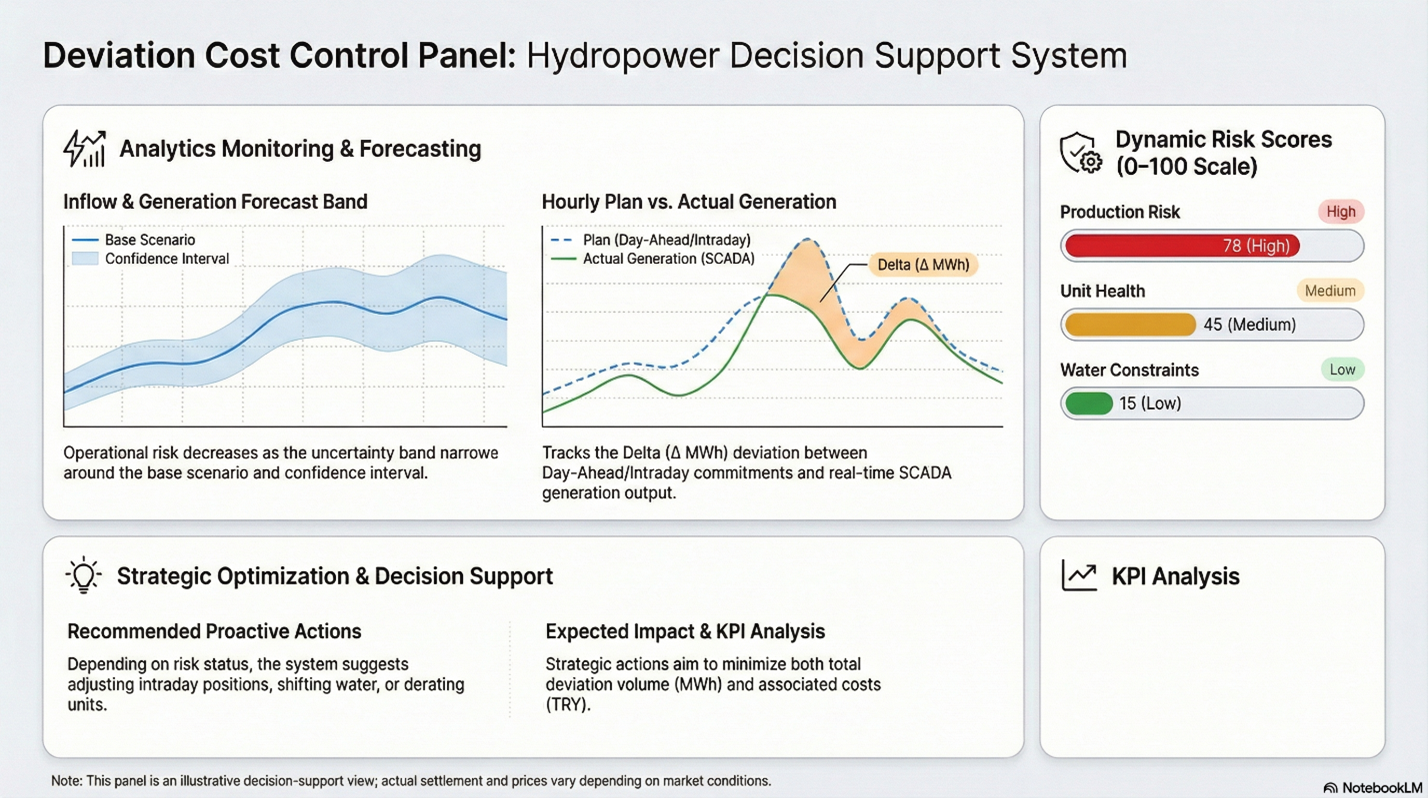
Forecast bands, plan vs. actual generation (Δ MWh), and real-time risk scores are combined to trigger proactive actions—intraday adjustment, water shifting, and unit derating to reduce both deviation volume and deviation cost.
FAQ
Conclusion + CTA
Balancing costs and deviation management in hydropower are not just market mechanics they are a reflection of how well water, equipment, and market positioning are coordinated throughout the day. Reactive workflows explain deviations after the fact. Proactive workflows reduce them early by turning forecast uncertainty and SCADA reality into clear action rules: adjust intraday position when the band shifts, re-time water when constraints tighten, and protect unit health before drift becomes a forced derate. [4][7]
The good news is you don’t need a massive transformation to start. A single view that combines forecast bands + plan vs. actual + risk scores immediately improves decision speed, and a simple playbook turns that visibility into measurable results. If deviation meetings have become routine and decisions still rely on end-of-day context, it’s time to move the conversation earlier into the hours where you can still change the outcome. [7]
CTA: Want to see what a proactive deviation workflow looks like for your HPP? Let’s map your current process (data sources, update windows, constraints) and build a pilot decision-support flow with alerts and intraday action rules.