Failure Kanban Approach: SLA-Based Standardization of Maintenance Workflow in Energy Facilities
Introduction: Uncontrolled Workload in Field Operations
Failures in energy facilities are inevitable; however, the way they are managed is often not systematic. In many sites, work orders are communicated through multiple channels: SCADA alarms, operator notifications, phone calls, or emails. This situation reduces the visibility of the maintenance workflow and makes the prioritization process uncertain.
Under a reactive intervention approach, teams often focus first on the most loudly reported or most visible problem. However, this model can lead to delays in addressing critical equipment failures, SLA violations, and unbalanced utilization of field capacity. In critical infrastructure systems, this creates not only operational but also financial risk.
The literature emphasizes that maintenance processes should be designed not only with technical decision criteria but also in alignment with workflow policies [1]. Similarly, planning approaches that consider SLA constraints have been shown to achieve lower violation rates and more balanced resource utilization [2].
In this context, the Failure Kanban approach aims to enhance operational discipline by visualizing field maintenance workflows, standardizing prioritization criteria, and making intervention time measurable.
TL;DR
- The Failure Kanban approach provides standardization by visualizing field maintenance workflows.
- Kanban systems can be optimized together with maintenance policies [1].
- SLA-based prioritization can reduce service-level violations and intervention delays [2].
- The planning phase plays a critical role in generating operational value from Kanban implementation [3].
- Digital integration and performance measurement transform maintenance processes from an intuitive model into a data-driven model.
- Concepts and Background
- Adapting Kanban Logic to Maintenance Processes
The Kanban system is a management approach that aims to improve process performance by visualizing workflow and limiting the amount of simultaneous work. Its core principles include visualization, limiting Work in Progress (WIP), and flow-oriented management.
Recent studies show that Kanban systems can be modeled not only in production environments but also in conjunction with maintenance policies. The study titled “Single-stage Kanban system with deterioration failures and condition-based preventive maintenance” demonstrates that Kanban policy and condition-based maintenance can be jointly optimized [1]. In this model, the Kanban policy, preventive maintenance policy, and control plan are evaluated and optimized within the same framework.
This finding indicates that workflow design should not be treated separately from maintenance strategy. In other words, the maintenance process is not merely a technical failure response but also a flow management problem.
The Kanban approach adapted to maintenance processes is based on three fundamental principles:
- Consolidating all work into a single visible system
- Limiting the number of concurrent tasks
- Focusing on completing tasks rather than merely starting them
This structure balances field team workload and makes intervention processes measurable.
- SLA and Prioritization Mechanism
Service Level Agreements (SLAs) define the time targets within which maintenance activities must be completed. In energy facilities, especially for critical equipment failures, intervention times may be contractually or operationally defined.
A stochastic modeling study on the railcar maintenance problem shows that a predictive maintenance approach reduces SLA violations and lowers total cost [2]. Compared to a deterministic model, the following outcomes were achieved:
- Fewer SLA violations
- Lower total cost
- Fewer corrective maintenance interventions
These results demonstrate that the prioritization mechanism within maintenance workflows should rely on systematic criteria rather than intuition.
In the Failure Kanban approach, these criteria typically include:
- SLA duration
- Critical equipment classification
- Safety risk
- Production impact
- Operational Impact of the Planning Phase
The success of a Kanban system depends not only on board design but also on the quality of the planning phase. An empirical study conducted on 118 companies shows that the Kanban planning phase is directly associated with operational benefits [3]. The quality of preliminary analysis and integration is among the key factors determining system performance [3].
This finding indicates that a maintenance Kanban system is not merely a digital tool but a management approach requiring structured process design.
- How Does the Failure Kanban Model Work?
The Failure Kanban approach functions by visualizing maintenance workflow, standardizing prioritization mechanisms, and making performance measurable. This section explains the model structure from a field implementation perspective.
- Kanban Column Structure
The recommended basic Kanban workflow for maintenance processes is as follows:
- New Request
- Priority Analysis
- Planned
- In Field
- Inspection / Test
- Closed
This structure enables tracking of a failure record from initial notification to final closure
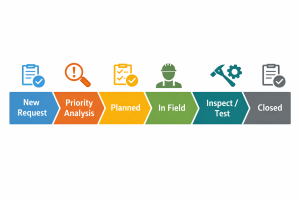
(Figure 1. The Breakdown Kanban process flow illustrates the standard progression steps a work order follows from the request phase through to closure.)
- SLA-Based Color Coding
Visually distinguishing tasks whose SLA deadlines are approaching or at risk of violation is critically important [2].
The proposed color-coding model is as follows:
- Red → High risk of SLA violation
- Orange → SLA deadline approaching
- Green → Within planned intervention window
This visualization enables managers to quickly identify high-risk tasks and prioritize intervention accordingly.
| Low Criticality | High Criticality | |
| SLA Far | Planned Task | Monitor Closely |
| SLA Near | Priority | Emergency Intervention |
(Figure 2. Prioritization of tasks based on SLA duration and equipment criticality level.)
- WIP (Work in Progress) Limits
One of the fundamental principles of the Kanban system is limiting the number of concurrent tasks.
Example field implementation:
- Maximum of 5 active tasks in the field
- Maximum of 3 tasks in the inspection stage
- Maximum of 10 open records in the priority analysis stage
These limits:
- Prevent team overload
- Reduce the risk of tasks remaining unfinished or delayed within the workflow
- Increases process flow speed.
- Key Performance Indicators (KPIs)
The primary metrics recommended for measurement in a Failure Kanban system include:
- Mean Time to Repair (MTTR)
- SLA Compliance Rate (%)
- Number of Open Tasks
- Waiting Time
- Recurring Failure Rate
These metrics enable not only the execution of maintenance processes but also their continuous improvement.
- The Impact of the Failure Kanban Approach in Energy Facilities
Maintenance processes in energy facilities are not merely technical operations; they directly determine production continuity. In asset-intensive facilities such as hydroelectric power plants (HPPs), critical equipment failures result in production losses and revenue decline.
An abnormal increase in turbine bearing temperature or a rise in generator vibration levels may initially appear as minor technical deviations. However, if these signals are not addressed in time, they can escalate into unplanned downtime. Unplanned downtime creates not only repair costs but also production loss costs.
The literature demonstrates that maintenance planning has a direct impact on service levels and total cost [2]. In reactive models where SLA constraints are not considered, resources may be allocated to non-critical tasks while high-risk equipment is delayed. In energy facilities, this can lead to significant operational consequences.
The Failure Kanban approach provides three primary benefits in this context:
- Increased visibility of critical equipment
- Objective prioritization criteria
- Measurable intervention times
In facilities such as HPPs, a large proportion of failures are labeled as “urgent.” However, in a system where everything is urgent, nothing is truly prioritized. The Kanban approach brings structure and control to this complexity.
Mini Scenario: Turbine Cooling Pump Failure
Assume that increased vibration is detected in a turbine cooling pump at a hydroelectric power plant.
Scenario 1 – Reactive Model:
An operator creates a notification, and the team intervenes when available. At the same time, three other failure records exist. Priorities are unclear. The pump failure progresses, leading to an unplanned shutdown.
Scenario 2 – Kanban + SLA Model:
The vibration alarm automatically generates a work record.
SLA duration and equipment criticality score are calculated.
The task is categorized as red.
Due to WIP limits, a lower-priority task is postponed.
Intervention is performed in a controlled and planned manner.
In the second scenario, the risk of production loss is significantly reduced.
- Digital Platform Perspective: Implementation Layer with Hydrowise
The Failure Kanban approach can be designed theoretically; however, its sustainability depends on digital infrastructure. Physical boards or manual tracking methods may be sufficient initially, but considering the data volume and alarm intensity in energy facilities, the process must be managed through a digital system.
Within the Hydrowise platform, the maintenance workflow is designed to operate in integration with SCADA and sensor data. Through this structure:
- A SCADA alarm can automatically generate a work record
- The work record is linked to the relevant equipment
- SLA duration is monitored by the system
- The intervention process is tracked via the Kanban board
This integration transforms failure reporting from manual notification into an automated workflow.
When combined with a predictive maintenance module, the system can incorporate not only actual failures but also high-risk equipment into the Kanban flow. The literature indicates that predictive approaches can reduce SLA violations and corrective interventions [2]. Therefore, data-driven early warning mechanisms enhance the effectiveness of the Kanban system.
Within Hydrowise, the process operates as follows:
- An alarm or risk score is generated
- The system creates a work record
- A priority score is calculated (SLA + criticality)
- WIP control is applied
- The task becomes visible on the board
- Upon completion, performance metrics are updated
This structure transforms maintenance operations from a monitored process into a measured and optimized system.
The objective is to support Kanban methodology with a digital flow management layer, making field team capacity more balanced and predictable.
- Conclusion and Evaluation
The effectiveness of maintenance processes in energy facilities depends not only on technical expertise but also on how workflows are managed. The Failure Kanban approach enhances operational discipline by making intervention processes visible, measurable, and prioritizable.
The literature demonstrates that Kanban systems can be optimized in conjunction with maintenance policies [1]. Similarly, planning models that incorporate SLA constraints achieve lower violation rates and more balanced resource utilization [2]. The importance of the planning phase has been empirically validated [3].
These findings indicate that maintenance processes in energy facilities should not rely solely on reactive intervention models but should be approached from a flow management perspective.
The Failure Kanban approach:
- Increases visibility of critical equipment
- Links intervention priorities to objective criteria
- Makes SLA compliance measurable
- Balances team capacity
- Makes process performance measurable
With digital platform integration, this structure shifts maintenance operations from intuitive decision-making to data-driven management.
For organizations seeking to make maintenance processes in energy facilities more controlled and predictable, the Failure Kanban approach offers a practical and scalable framework.
- Frequently Asked Questions1- What is the main difference between Failure Kanban and a traditional work order system?
Traditional work order systems are typically record- and archive-focused. The Kanban approach visualizes workflow, applies WIP limits, and makes every stage of the process traceable. Thus, not only task records but also flow performance are managed.2- Can the Kanban system function if all tasks are marked as “urgent”?
No. If prioritization criteria are not clearly defined, the system quickly loses effectiveness. Measurable parameters such as SLA duration, equipment criticality level, and production impact must be used [2].3- Do WIP limits reduce field team speed?
In the short term, starting fewer tasks may create a perception of slowdown. However, when completed tasks and average intervention time are analyzed, workflow becomes more balanced and predictable.4- Can Failure Kanban be implemented without predictive maintenance?
Yes. However, predictive data integration enables early prioritization of high-risk equipment and may reduce SLA violation risk [2]. Therefore, integration is recommended.5- Which KPI is most critical in energy facilities?
SLA compliance rate and Mean Time to Repair (MTTR) are typically the primary indicators. Additionally, recurring failure rate provides important insights into system health.