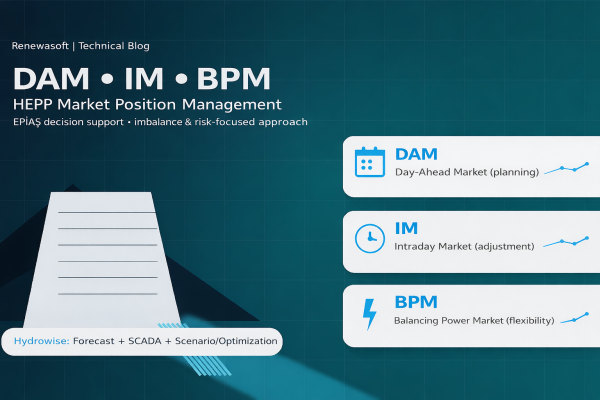
Target Audience: HES operators, SCADA engineers, energy company managers
Meta description: A practical guide for HES operators on how to position in GÖP, GİP, and DGP-step by step, with risk, deviation (imbalance) cost, and Hydrowise decision-support workflow.
Keywords: GÖP, GİP, DGP, EPİAŞ, PTF, SMF, imbalance/deviation, HES energy trading
GÖP / GİP / DGP: How Should a HES Operator Position Across Markets?
Hook + problem statement
Same water, same turbine, same installed capacity yet a HES plant’s monthly revenue can look completely different simply because of how positions are taken in the market. In Türkiye’s electricity markets, revenue is not determined only by how much you generate; it is shaped by where you place that generation, when you commit it, and what risks you carry.
Day-Ahead Market (GÖP) provides planning and visibility; Intraday Market (GİP) protects you against forecast errors; Balancing Power Market (DGP) offers the possibility of monetizing flexibility. But if these three markets are not managed together, “deviation” grows, imbalance costs eat into revenue, and the operations team gets stuck in a reactive loop. [1][2][3]
Info Note
This article answers one core question from a HES operator’s perspective:
How do we position in each market and how do we make that positioning systematic?
TL;DR
- GÖP is the main planning layer where bids are submitted for the next day’s 24 hours and hourly PTF is formed; the bidding and publication timeline follows a clear daily process. [1]
- GİP is the correction layer that reacts to new information during the day (inflow/weather/outage/transmission constraints); it runs as a continuous trading platform and the gate closure is 1 hour before physical delivery. [2]
- DGP is activated to maintain real-time system balance; it is the offer pool used by MYTM for balancing and relies on capacity that can respond within 15 minutes. [3]
- For HES operators, the key is not “which market is better,” but how to manage forecast errors and allocate volume across markets using water/reservoir constraints and flexibility (the balance between deviation cost and revenue). [4][5]
Concepts / background
GÖP (Day-Ahead Market)
GÖP is the market where participants submit bids for the next day’s 24 hours and hourly matching produces PTF (Piyasa Takas Fiyatı). Submission, validation, optimization, and final publication run in defined time windows. [1]
GİP (Intraday Market)
GİP is the market that allows you to adjust your position using new information during the day. EPİAŞ states that matching in GİP occurs via the continuous trading method and that transactions can be carried out at any time during the day. [2]
DGP (Balancing Power Market)
DGP is the mechanism used by the system operator (MYTM) to protect real-time supply–demand balance. EPİAŞ emphasizes that DGP provides MYTM with “reserve capacity that can be activated within a maximum of 15 minutes” for real-time balancing. [3]
Info Card
Purpose & Mechanics of GÖP: The core purpose is to trade electricity on an hourly basis one day before physical delivery and to determine PTF (Piyasa Takas Fiyatı), which serves as a market-wide reference price; the operational logic is based on intersecting buyers’ and sellers’ offers through supply–demand curves. [7]
Purpose & Mechanics of GİP: It aims to eliminate supply–demand imbalances that emerge after GÖP closes; it operates as an uninterrupted (continuous) trading platform under a “first come, first served” rule until 60 minutes before delivery. [8]
Purpose & Mechanics of DGP: It is operated by TEİAŞ to maintain instantaneous system balance; it functions through Yük Alma (YAL) / Yük Atma (YAT) instructions given to units that can respond within 15 minutes, and through marginal pricing (SMF). [9]
PTF vs SMF
PTF is the “clearing/settlement price” formed as a result of market matching. [1]
SMF (Sistem Marjinal Fiyatı) is a key price reference monitored in the balancing framework, and EPİAŞ annual reporting also provides PTF–SMF comparisons. [4]
Deviation / imbalance
Deviation (imbalance) is the difference between planned generation/consumption and realized generation/consumption. As deviation grows, settlement/imbalance components become active; that is why GİP and accurate forecasting/monitoring become critical for “revenue protection.” (For settlement and imbalance mechanisms, see EPİAŞ materials and training resources: [6])
Hydrowise brings this together by making GÖP, GİP, DGP decisions manageable “from a single screen” through Forecast + SCADA data + scenario/optimization: proactive position management instead of reactive firefighting.
Info Note
“EPİAŞ’s short training video provides a useful overview of how settlement and imbalance prices (PTF/SMF) appear in practice.” [6]
Technical Note: Three markets, one decision problem
Many teams handle GÖP, GİP, and DGP as three separate jobs: “the GÖP person,” “the GİP person,” “the DGP person.” But for a HES plant, there is one integrated decision problem:
(1) How much water should I release, and in which hours?
(2) How much of that volume should I monetize in each market?
If these two decisions are decoupled, one side grows “revenue” while the other side grows “risk.” That is exactly why a decision-support approach is necessary.
How does it work?
GÖP flow: where you build the plan
On EPİAŞ’s GÖP processes page, the timeline is clearly stated: bids for the next day are submitted until 12:30; hourly PTF and volumes are determined via optimization between 13:00–13:30; and final results are published at 14:00. [1]
What this means for a HES operator:
If you expect “18:00–22:00 will be expensive tomorrow,” you want to allocate water to those hours.
But if inflow is uncertain or there is equipment/gate/transmission risk, loading your entire position into GÖP increases deviation risk.
GİP flow: where you correct the plan
EPİAŞ clearly states that matching in GİP is based on the continuous trading method, that transactions are hourly-based, and that gate closure is 1 hour before physical delivery. [2]
What this means for a HES operator:
New rainfall/snowmelt information arrives before the evening peak → inflow increases/decreases → the GÖP plan should be revised.
Turbine efficiency starts to drop → you will generate fewer kWh with the same water → you should shrink deviation via GİP.
A transmission constraint appears → price dynamics change → a spread opportunity may emerge.
2024 comparison: the scale of GÖP vs GİP (EPİAŞ)
| Indicator (2024) | GÖP | GİP |
|---|---|---|
| Matched Volume | 230.16 TWh | 15.17 TWh |
| Trading Volume | 67.38 billion TL | 142.87 million TL |
| Market Quantity Distribution (Share) | 39.80% | 2.62% |
| Average PTF (system-wide reference) | 2,235.52 TL/MWh | 2,235.52 TL/MWh |
Table-1 clearly shows that, in 2024, GÖP is the market’s primary “planning and liquidity” center: matched energy is 230.16 TWh in GÖP versus 15.17 TWh in GİP. Similarly, trading volume is 67.38 billion TL in GÖP and 142.87 million TL in GİP. For HES operators, the practical takeaway is simple: the core position should generally be built in GÖP, while GİP should be used as a “correction band” when uncertainty (inflow/outage/demand) increases. [10]
DGP logic: monetizing flexibility (but not guaranteed)
EPİAŞ explains that real-time events (outages or sudden consumption changes) can disturb balance and that MYTM then uses offers submitted to DGP to restore balance. It also highlights the connection between DGP and capacity that can be activated within 15 minutes. [3]
What this means for a HES operator:
If you can ramp up/ramp down quickly, DGP opportunities can arise.
However, DGP is not “guaranteed daily revenue”; activation depends on system needs.
To include DGP in your strategy, you must consider “activation probability / flexibility cost / water value” together.
Info Card: the “most critical hour” concept for HES
In HES trading, success is often decided not across all 24 hours but within a few critical hours:
- Hours where PTF peaks
- Hours where DGP activation intensifies
- Hours where deviation costs are highest
That is why you need hourly visibility price, risk, flexibility at the dashboard level. (For PTF–SMF comparisons and hourly reporting examples: [4])
Impact on the HES / plant side
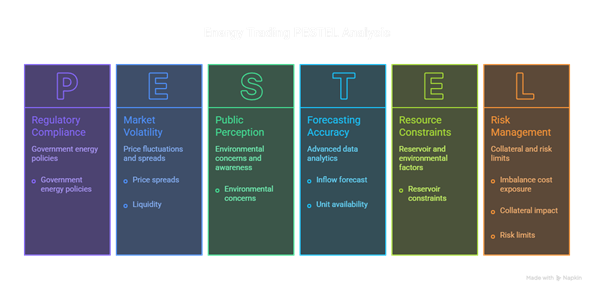
Five on site realities that distort market positioning
- Inflow uncertainty: water inflows can change during the day (especially during seasonal transitions).
- Efficiency variability: turbine efficiency changes with head, temperature, and equipment condition.
- Operational constraints: minimum flow, environmental limits, tailwater conditions, gate limits.
- Outage/planned maintenance effects: unplanned stops directly break the GÖP plan.
- Transmission/system constraints: regional constraints can change price behavior.
This leads to one conclusion:
The quality of your market decision depends as much on “measurement and feedback” as it does on “forecasting.”
What happens when deviation grows?
When deviation grows, settlement/imbalance components begin to drive financial outcomes. On the producer side, it shows up very practically:
- End-of-day “why is deviation so high?” meetings
- Trading team: “I got the price right.”
- Operations team: “the field reality changed.”
- Finance: “what is the imbalance cost?”
This loop is typically rooted in not treating GÖP–GİP–DGP as a single decision process.
Collateral and risk-management dimension
EPİAŞ states that imbalance collateral calculation uses elements such as historical negative imbalance quantities, SMF averages, and a risk coefficient. [5]
This means deviation is not only “today’s cost”; as your risk profile grows, collateral/financing pressure grows as well.
Risk Box: Why “just forecasting price” is not enough?
Positioning based only on PTF forecasts is incomplete for HES. Because revenue = price × volume, and “volume” changes on site.
The most common failure pattern:
“We allocated water to high-PTF hours” → “inflow/efficiency didn’t match” → “deviation grew” → “revenue eroded.”
A strong strategy requires price forecasting + generation forecasting + operational risk visibility.
Example scenario / mini calculation / flow
Let’s make the “how should I think?” question tangible with a mini workflow. This is not financial advice; the goal is to show decision logic.
Scenario: Reservoir-based HES targeting the evening peak
Prices are expected to rise in the evening peak tomorrow.
Reservoir is sufficient, but inflow forecast has uncertainty.
•A small increase in turbine vibration is observed (not a failure, but a risk signal).
Step 1 — Build the “core” position in GÖP
GÖP is where you build the plan. According to EPİAŞ’s timeline, bids are submitted until 12:30 and PTF/volumes are determined via optimization between 13:00–13:30. [1]
The objective: lock in revenue without carrying all risks.
Practical rule:
“Energy you can generate with high confidence” → GÖP
“Energy that is uncertain but possible” → GİP/DGP option
Step 2 — Use GİP like “insurance”
GİP is the real-time correction layer via continuous trading, with gate closure 1 hour before delivery. [2]
Did inflow get updated? Is turbine efficiency lower than expected?
Use GİP transactions to move the GÖP volume closer to physical reality.
Step 3 — Treat DGP as a “flexibility option”
DGP is a tool used by MYTM for real-time balancing; the “activation within 15 minutes” concept is decisive here. [3]
Fast response is a HES advantage, but activation is not guaranteed.
Mini flow (decision schema)
(1) Production confidence interval → (2) GÖP core volume → (3) GİP correction band → (4) DGP flexibility option → (5) Deviation/collateral impact check
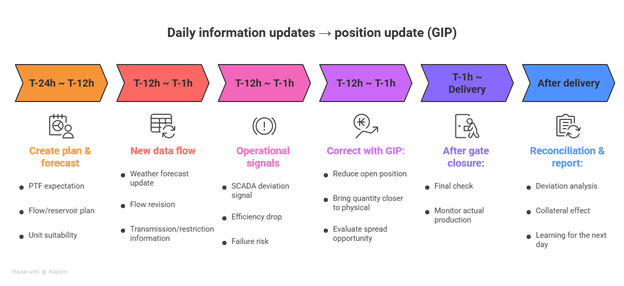
As HES production uncertainty increases, the GİP band expands; DGP remains positioned as a separate flexibility option.
As inflow/weather/outage signals arrive, GİP is used to align the position closer to physical reality.
Infographic Draft: Strategic Market Decision Band for HES Operators
| MARKETS (Timeline) | DECISION BAND (Strategy) | RISKS & RECOMMENDED ACTIONS |
|---|---|---|
| GÖP (Day-Ahead Market) Delivery day -1 (until 12:30) |
CORE PLANNING: Maximize reservoir management and water value. Build KGÜP by allocating generation to “peak” hours where PTF is highest. | Risk: Meteorological uncertainty in expected inflow volumes and price forecast errors. Action: Use basin-level optimization models to plan the most accurate water allocation. |
| GİP (Intraday Market) Until 60 minutes before delivery |
CORRECTION PROCESS: Balance the deviation between GÖP commitments and realized hydrological data. Close “open position” through dynamic portfolio management. | Risk: Volume risk; mismatch in production forecast and inability to match due to low market liquidity. Action: Monitor forecast updates in real time and take positions in GİP to avoid falling into imbalance cost. |
| DGP and Ancillary Services Real-time balancing |
OPTIONAL REVENUE: Use plant ramping capability (load take/load shed speed) to respond to YAL/YAT instructions from TEİAŞ and provide frequency control services. | Risk: Operational risks; inability to execute instructions due to technical failures or ramping constraints. Action: Offer fast-response units as reserve capacity to DGP and generate additional revenue via SMF. |
Table-2
Hydrowise / Renewasoft approach
How the problem shows up on site
Operations wants to “place water into hours,” trading wants to “catch the price.”
If SCADA data from the field (kW, inflow, gates, vibration, temperature) does not reach trading decisions on time, decisions are made using “last night’s assumptions.”
Result: deviation meetings, imbalance cost, and collateral pressure. [5]
What does Hydrowise do here?
Hydrowise is positioned as a data-driven HES management and decision-support framework rather than a standalone market-trading engine.
It focuses on integrating forecasting, SCADA visibility, and scenario-based analytics to support operational and strategic decisions across GÖP–GİP–DGP workflows.
Think of Hydrowise as modular and adaptable to the maturity level of your plant:
(A) Forecast & Scenario Analytics
Price side: PTF is evaluated through scenario-based modeling (high / medium / low distributions) instead of relying on a single deterministic forecast.
Generation side: inflow projections, reservoir constraints, and operational efficiency indicators are incorporated into decision scenarios to make “volume risk” visible before commitments are made.
This does not replace EPİAŞ systems; it enhances internal decision quality before market actions are taken.
(B) SCADA-Based Operational Visibility
Hydrowise enables real-time visibility of field signals (kW output, inflow, gates, vibration, temperature) within a unified analytics interface.
The objective is early detection of deviations between planned and realized production — allowing trading and operations teams to align decisions within available market windows (e.g., GİP).
(C) Market Decision-Support Layer (Customizable / Development-Oriented)
Rather than acting as a direct bidding system, Hydrowise supports:
• Structured pre-GÖP planning workflows
• GİP correction-threshold analytics
• Flexibility visibility for DGP participation
For operators seeking a more advanced orchestration layer, Renewasoft can design customized decision-support modules tailored to portfolio size, flexibility characteristics, and internal workflows.
(D) Operational Risk & Predictive Analytics (Expandable Capability)
Hydrowise can incorporate vibration trends, efficiency degradation signals, and operational anomalies into analytics dashboards.
While not positioned as a standalone predictive maintenance product, this data layer helps quantify production certainty and supports more risk-aware market positioning.
Organizations interested in deeper predictive maintenance integration can work with Renewasoft to design advanced analytics modules specific to turbine and hydrological behavior.
Actionable recommendation: a “minimum decision support” MVP in 2 weeks
A practical starter set for HES operators:
- Pre-GÖP checklist (before 12:30): inflow forecast freshness, unit readiness, maintenance plan, constraints. [1]
- GİP correction alert: if realized generation deviates beyond X% of the plan, propose a “GİP action.” [2]
- Deviation & collateral dashboard: visualize risk profile while considering imbalance collateral logic. [5]
- Scenario screen: compare revenue–risk under “PTF high / medium / low” scenarios.
Frequently asked questions (5–8)
Is GÖP more profitable, or GİP?
There is no single answer. GÖP builds the plan; GİP corrects uncertainty. As uncertainty rises, the value of GİP rises. [1][2]
Until when can trades be executed in GİP?
According to EPİAŞ, GİP gate closure is one hour before physical delivery. [2]
Does DGP generate revenue every day?
No. DGP is activated based on system needs; MYTM uses DGP offers for balancing. [3]
Why are PTF and SMF monitored together?
PTF reflects market matching; SMF reflects balancing-side price dynamics. EPİAŞ reports also provide PTF–SMF comparisons. [4]
What is the biggest risk for a HES plant—price or production?
In practice, “volume risk” (inflow/efficiency/outage) often hurts faster than price risk, because it triggers deviation costs.
Why does imbalance collateral matter?
EPİAŞ notes that imbalance collateral is calculated using historical negative imbalance quantities and SMF averages, among other factors; a higher risk profile can increase collateral burden. [5]
Can we manage without a decision-support system?
Manual management works up to a point for small plants, but as uncertainty, portfolio scale, and market volatility grow, reactive operations become inevitable.
Conclusion + CTA
GÖP, GİP, and DGP are not “three separate markets” for a HES operator; they represent one integrated position-management problem. You build the plan in GÖP, align the plan to physical reality in GİP, and pursue flexibility-based opportunities in DGP. What makes this sustainable is the trio of forecasting + real-time data + scenario/optimization. [1][2][3]
Next steps (actionable):
- Week 1: define a pre-GÖP checklist + a GİP correction threshold.
- Week 2: bring core SCADA KPIs (kW, inflow, gates, vibration/temperature) into a single view.
- Week 4: standardize “core + correction band + option” scenarios across GÖP–GİP–DGP.
CTA (demo call):
If “deviation meetings” have become routine at your HES plant and GÖP–GİP decisions feel disconnected from the field, we can model your workflow via a demo using Hydrowise Forecast + SCADA + EPİAŞ decision support. (Internal link: Renewasoft Demo Request)
References
- [1] EPİAŞ – Day-Ahead Market (GÖP) process & market definitions
- [2] EPİAŞ – Intraday Market (GİP): continuous trading & gate closure information
- [3] EPİAŞ / TEİAŞ – DGP, MYTM, and the “activation within 15 minutes” reserve capacity approach
- [4] EPİAŞ reports – PTF–SMF comparisons
- [5] EPİAŞ – Collateral / imbalance risk components
- [6] EPİAŞ training materials – settlement and imbalance video/resources
- [7]–[9] EPİAŞ/TEİAŞ market operation explanations (GÖP/GİP/DGP purpose & mechanics)
- [10] EPİAŞ 2024 market comparison indicators used in Table-1