What Is a Digital Twin Used for in Hydropower Plants? Practical Scenarios, Architecture Layers, and the Hydrowise Roadmap
The performance of a real hydroelectric power plant (HPP) is often summarized in a single number (MW). Yet the answer to “why this MW?” is hidden in the joint behavior of many variables: waterway head loss, turbine efficiency, gate/wicket settings, vibration, bearing temperature, signs of cavitation, transmission constraints, and even maintenance history. A digital twin comes into play precisely here: by establishing a continuous data exchange between the physical asset and its digital representation, it aims to go beyond “current state” and produce diagnosis, prediction, and optimization [1][2].
Today, the term digital twin is sometimes confused with a “3D model,” a “simulation,” or a “dashboard.” What differentiates a digital twin is that it combines lifecycle-updated models with field data to produce decision support [3][1]. NIST likewise positions the core function of digital twins as producing prediction/optimization in addition to being a state indicator [2].
In this blog, we explain the digital twin for HPPs with scenarios that generate real value: turbine efficiency monitoring, early warning of failure signals, alarm correlation, behavior analysis during outage scenarios, water management, and maintenance planning. Then we summarize an implementation-oriented architecture template and how these capabilities can be productized with a Hydrowise/Renewasoft approach.
1) TL;DR (5 points)
- A digital twin is not a dashboard or a static model. It is a “living” system that ingests field data, validates the model, and produces decision recommendations [1][2][3].
- In HPPs, the fastest value-generating digital twin scenarios usually fall into three groups: efficiency/performance monitoring, predictive maintenance, and operational optimization.
- A successful digital twin cannot be sustained without data quality (timestamp synchronization, tag standardization, quality flags), model governance (calibration, versioning), and security (OT/IT boundaries) [4][5].
- Instead of a “single big twin,” it is more realistic to start with narrow-scope twins for critical assets/lines (turbine, generator, waterway) and then merge over time [6].
- From the Hydrowise perspective, the digital twin becomes operational value when handled together with SCADA/IoT integration, a time-series data layer, analytics/ML, and alarm management modules.
2) Concepts and theoretical background
2.1 What is a digital twin—and what is it not?
It is useful to think of the digital twin concept in three levels:
- Digital model: a mathematical/3D/parametric representation of the physical asset (one-way).
- Digital shadow: data flows from field to digital; the digital side is updated but feedback is limited.
- Digital twin: data flow runs near real time; the model is validated/calibrated; outputs are tied to operational action (warning, recommendation, optimization) [1][2].
NIST emphasizes the role of digital twins in producing predictions and state indicators and focuses on verification/test methodologies and requirements definition [2]. ISO 23247 aims to standardize the digital twin framework at the level of terminology, requirements, and general principles [3].
Technical Note: “Minimum viable” definition of a digital twin
For an HPP digital twin to be considered a digital twin at MVP level, three conditions are typically required:
1) Continuous data flow from the field (SCADA/IoT)
2) A validated model based on that data (physical/statistical/hybrid)
3) Connecting model outputs to operations (KPI, alarm, recommendation, maintenance action)
(Basis: standardization and definition approaches [2][3])
2.2 In the HPP context, “the twin of what asset” is it?
In an HPP, the digital twin does not have to be a copy of a single thing. Common scopes in practice:
- Asset twin: turbine, generator, transformer, bearing/oil system
- Process twin: waterway + turbine + generator production chain (head, flow, gate/wicket)
- Operations twin: production plan, failure/maintenance work orders, alarm management, KPI dashboards
Recent studies on digital twin applications in hydropower link them to real-time data, predictive maintenance, and adaptive operational strategies [6][7].
3) How does it work? Layers of a digital twin architecture
3.1 Data layer (SCADA/IoT integration)
- Tag standard and inventory: (kW, flow, gate, vibration RMS, bearing temperature, etc.)
- Time synchronization: without NTP/PTP the twin’s “time” drifts.
- Data quality: quality flags, outliers, missing data, sensor drift
- Outage resilience: reducing data loss with edge buffer/gateway even if the connection drops
3.2 Model layer (physical / statistical / hybrid)
- Physical models: efficiency curves, head–flow–power relations, friction losses
- Statistical models: trends, regression, correlation, control limits
- ML models: anomaly detection, fault classification, remaining useful life (RUL)
When hydraulic and mechanical behavior are evaluated together, a hybrid approach is often more robust [7].
3.3 Synchronization and calibration (model management)
- Parameter calibration (e.g., fitting the turbine efficiency map to field data)
- Versioning: when the model changes, before/after differences must be traceable
- Monitoring: model drift, performance metrics, alarm false-positive rate
3.4 Decision and action layer
- Alarm/warning: efficiency drop, vibration trend increase, sensor fault
- Recommendation: optimal gate/wicket settings, maintenance prioritization
- Automation integration: controlled feedback within OT security boundaries
Risk Box: Most common reasons digital twin projects fail
- Data quality and time synchronization are neglected.
- Model/operations ownership remains unclear.
- A one-off PoC is done; lifecycle planning is not established.
- Integration is opened without considering OT security and access control [5].
- The effort stays at “demo model” level instead of being productized.
(Basis: NIST security and trust assessments for digital twin technology [5])
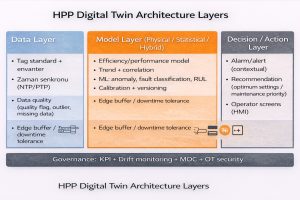
Caption: To generate operational value, the data–model–action chain must be designed end to end.
4) Impact on HPP operations: Where does it really make a difference?
4.1 Efficiency and performance deviations
A digital twin enables monitoring turbine efficiency not only in monthly reports but also “in real time and in context” by operating regime. If production drops at the same flow, is waterway loss increasing, did wicket settings drift, are there cavitation signs, or is a sensor faulty? These answers can be found faster by evaluating multivariate behavior together [7].
4.2 Predictive maintenance and failure prevention
Vibration, temperature, oil pressure, and electrical measurements can be early indicators of a failure. A digital twin can produce earlier warnings with fewer false alarms by evaluating these signals together with operating conditions. HPP-specific digital twin case studies also show that incomplete documentation and integration challenges are practically critical [4].
4.3 Alarm correlation and event investigation
A digital twin helps reach root cause faster by putting alarms into process context rather than a single tag. For example, a “vibration HH” alarm becomes more meaningful with the combination of efficiency drop + vibration trend + temperature increase.
4.4 Operational optimization
In multi-unit or multi-plant operations, production must be considered together with water-use efficiency, maintenance risk, and constraints. A digital twin strengthens scenario analysis and decision support [6][7].
5) Example scenario: Turbine efficiency digital twin (mini flow + calculation)
Goal: Detect drops in turbine efficiency early, reduce false alarms, and provide the operator with a clear recommended action.
Assumed SCADA measurements:
- Active power P (MW)
- Flow Q (m³/s)
- Net head H (m)
- Gate/wicket angles (%)
- Vibration RMS, bearing temperature, oil pressure
Mini calculation idea:
Hydraulic power can be approximated as Ph = ρ·g·Q·H. If production is assumed as P ≈ η·Ph, efficiency can be tracked approximately as η ≈ P / (ρ·g·Q·H). The objective here is not absolute efficiency but detecting relative deviation by operating regime.
Flow:
1) Data validation: time sync, outlier filtering, quality flags
2) Regime classification: select operating region based on Q and gate range
3) Efficiency deviation: compute deviation from expected η band in that regime
4) Correlation: evaluate deviation together with vibration/temperature trends
5) Action: produce recommendations such as “trash rack blockage check,” “wicket calibration check,” “maintenance inspection”
Info Card: Six quick win uses in an HPP digital twin
- Regime-based efficiency band monitoring
- Early warning via vibration/temperature trends
- Sensor drift / fault detection
- Alarm correlation (root cause)
- Backfill + data consistency checks during outages
- Risk-based maintenance prioritization
(Basis: hydropower digital twin application areas and architecture layers [4][6][7])
6) Hydrowise / Renewasoft approach: “Productizing the digital twin”
A digital twin creates value not as a single model file but as a productized workflow.
6.1 Integration and data standards
- Secure data flow over SCADA/OPC UA (outage resilience with edge buffering)
- Tag dictionary, unit standards, quality flags
- Scalable storage in the time-series data layer
6.2 Analytics and model management
- Regime-based KPIs (efficiency band, deviation, trend)
- Anomaly detection and maintenance signal extraction
- Model versioning and drift monitoring
6.3 Operational screens and actionability
- Operator view: “what happened, what could be the cause, what should I do now?”
- Maintenance view: “which asset is risky, which work order first?”
- Alarm management: correlation and classification
Internal link suggestions (site):
- /hydrowise/scada-entegrasyonu
- /hydrowise/gercek-zamanli-izleme
- /hydrowise/predictive-maintenance
- /renewasoft/ot-guvenligi
External authority sources:
- NIST Digital Twin Technology [2][5]
- ISO 23247 [3]
7) Frequently asked questions (FAQ)
1) Is a digital twin the same as a simulation?
A simulation is a model that runs under assumptions. A digital twin ingests field data, validates/calibrates the model, and connects outputs to action [2][3].
2) Where should we start for an HPP digital twin?
Fast value often comes from efficiency band monitoring + vibration/temperature trend analysis. Starting with a narrow-scope twin and expanding is more realistic [4][6].
3) How critical is data quality?
Very critical. Without time sync and quality flags, the model can produce incorrect results.
4) How can we reduce false-positive alarms?
Regime-based thresholds, trend windows, correlation rules, and operator feedback should be used together [5].
5) Does a digital twin make OT security harder?
If designed poorly, yes. The integration surface can expand. NIST emphasizes trust and cybersecurity in particular [5].
6) Should we build one big twin?
In most sites, starting with modular twins (turbine, generator, waterway) is more successful [6][7].
7) How is digital twin ROI measured?
Typical metrics include reduced unplanned downtime, earlier detection of efficiency loss, lower alarm noise, and better maintenance planning [1][7].
8) Conclusion
A digital twin in HPPs is not “more data,” but a way to produce better decisions. Unless field data flow, a validated model, and an action chain are established, a digital twin remains at the dashboard level [2][3]. The best results come from starting with narrow-scope, high-value scenarios (efficiency band, early warning trends, alarm correlation) and scaling with data and model governance in place [4][6][7].
Actionable next steps:
1) Inventory tags and standardize data quality/time synchronization checks.
2) Define a regime-based KPI set for the turbine efficiency band.
3) Add an “early warning + correlation” rule to vibration/temperature trends.
4) Deploy a digital twin MVP for a pilot unit within 4–8 weeks.
5) With Hydrowise, make KPI screens + alarm correlation + maintenance workflows actionable in one chain.
References (Numbered)
[1] Semeraro, C., et al. Exploring Digital Twin Implementation in Power Plants. 2025. (https://media.sciltp.com/articles/2506000795/2506000795.pdf) Accessed: 2026-02-22
[2] NIST. Digital twins. 2025. (https://www.nist.gov/digital-twins) Accessed: 2026-02-22
[3] ISO. ISO 23247-1:2021 Digital twin framework for manufacturing — Overview and general principles. 2021. (https://www.iso.org/standard/75066.html) Accessed: 2026-02-22
[4] Machalski, A., et al. The Concept of a Digital Twin for the Wały Śląskie Hydroelectric Power Plant: A Case Study in Poland. 2025. (https://doi.org/10.3390/en18082021) Accessed: 2026-02-22
[5] Voas, J., et al. NIST IR 8356: Security and Trust Considerations for Digital Twin Technology. 2025. (https://nvlpubs.nist.gov/nistpubs/ir/2025/NIST.IR.8356.pdf) Accessed: 2026-02-22
[6] Ohiemi, I. E., et al. Supporting the Digitalisation of Existing Hydropower Plants via Digital Twin Integration. 2025. (https://www.sciencedirect.com/science/article/pii/S0960148125018385) Accessed: 2026-02-22
[7] Machalski, A., et al. The Concept of a Digital Twin for the Wały Śląskie Hydroelectric Power Plant (Energies). 2025. (https://www.mdpi.com/1996-1073/18/8/2021) Accessed: 2026-02-22