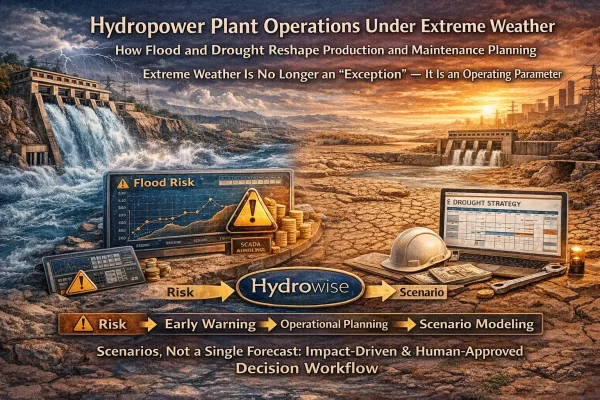
Hydropower Plant Operations Under Extreme Weather: How Flood and Drought Reshape Production and Maintenance Planning
Extreme Weather Is No Longer an “Exception” — It Is an Operating Parameter
For decades, production planning and maintenance strategies in hydropower plants (HPP/HES) were built around “seasonal normals” and historical averages. However, as the frequency and intensity dynamics of extreme weather events—such as heavy precipitation, flash floods, rain-on-snow interactions, and prolonged droughts—continue to shift, this approach is becoming increasingly fragile from both an operational safety and financial performance standpoint [1][2].
HPP operators are not merely forecasting river discharge; they are making decisions under uncertainty, managing market commitments, and preparing critical equipment for extreme loading conditions. Two structural realities define this new operating environment.
First, extreme weather is not purely a meteorological phenomenon. When combined with basin conditions, reservoir operations, equipment limits, SCADA alarm logic, and market obligations, it transforms into enterprise-level risk.
Second, a single-point forecast is no longer sufficient for decision-making. Scenario distributions, confidence scores, and human-approved workflows are required to translate uncertainty into controlled action.
This article presents, within an enterprise decision framework, how production and maintenance planning must adapt during flood and drought periods—structured around the sequence:
Risk → Early Warning → Operational Planning → Hydrowise Scenario Modeling.
- Floods and droughts create a dual-sided risk structure for hydropower plants (HPPs): one generates short-term peak discharge and equipment stress, while the other drives long-term capacity constraints and revenue erosion [1][5].
- Early warning is not limited to weather forecasting; it must integrate meteorological inputs + basin state + uncertainty modeling + operational and financial impact (production/revenue) in a single analytical framework [2][4].
- During flood periods, priority shifts toward safe operations and peak management; during drought conditions, the focus moves to water optimization and strategic maintenance windows.
- A human-in-the-loop approach enables auditable and traceable decision-making under uncertainty and represents an enterprise standard in critical infrastructure management [6][7].
- Hydrowise transforms forecasts into structured scenarios and converts those scenarios into measurable risk scores—establishing a shared decision framework across operations, trading, and executive management.
Enterprise Risk Taxonomy and Hydrometeorological Background
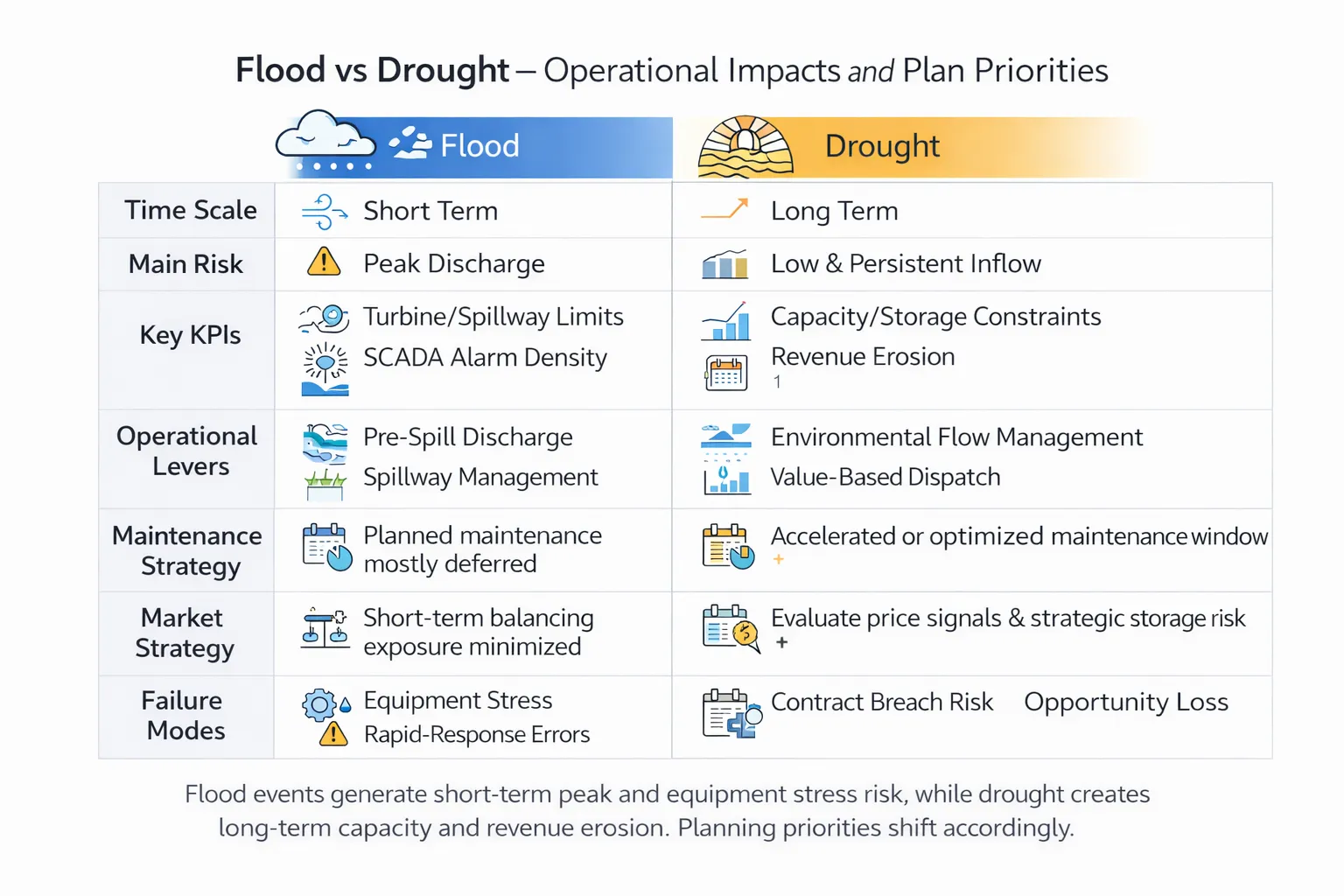
Figure. Human-in-the-Loop Prediction Workflow — AI generates prediction → Uncertainty analysis → Operator review → Approval/Revision → Market submission.
Managing extreme weather in hydropower operations requires more than monitoring forecasts; it requires understanding how meteorological conditions translate into operational and financial outcomes.
Extreme events—such as intense precipitation, flash floods, prolonged drought, heatwaves, and snow–rain phase transitions—are statistically rare but high-impact by nature [3]. For hydropower plants (HPPs), the strategic challenge is not the weather itself, but how it converts into discharge behavior within the basin.
This conversion is shaped by hydrological dynamics including soil saturation, Snow Water Equivalent (SWE), rain-on-snow interactions, basin response time, and reservoir operating rules. These variables determine whether the same forecast results in manageable inflow or critical peak stress.
From an enterprise perspective, two principles define effective risk governance.
First, risk must be decomposed into its structural components:
- Probability of occurrence
- Severity of impact
- Asset exposure
- Organizational tolerance thresholds
Second, forecasting must be impact-driven. The executive question is not “How much rainfall is expected?” but:
“When will which discharge band materialize—and what will be its operational and market impact?” [2]
This reframing transforms early warning from a technical metric into a decision-enabling mechanism.
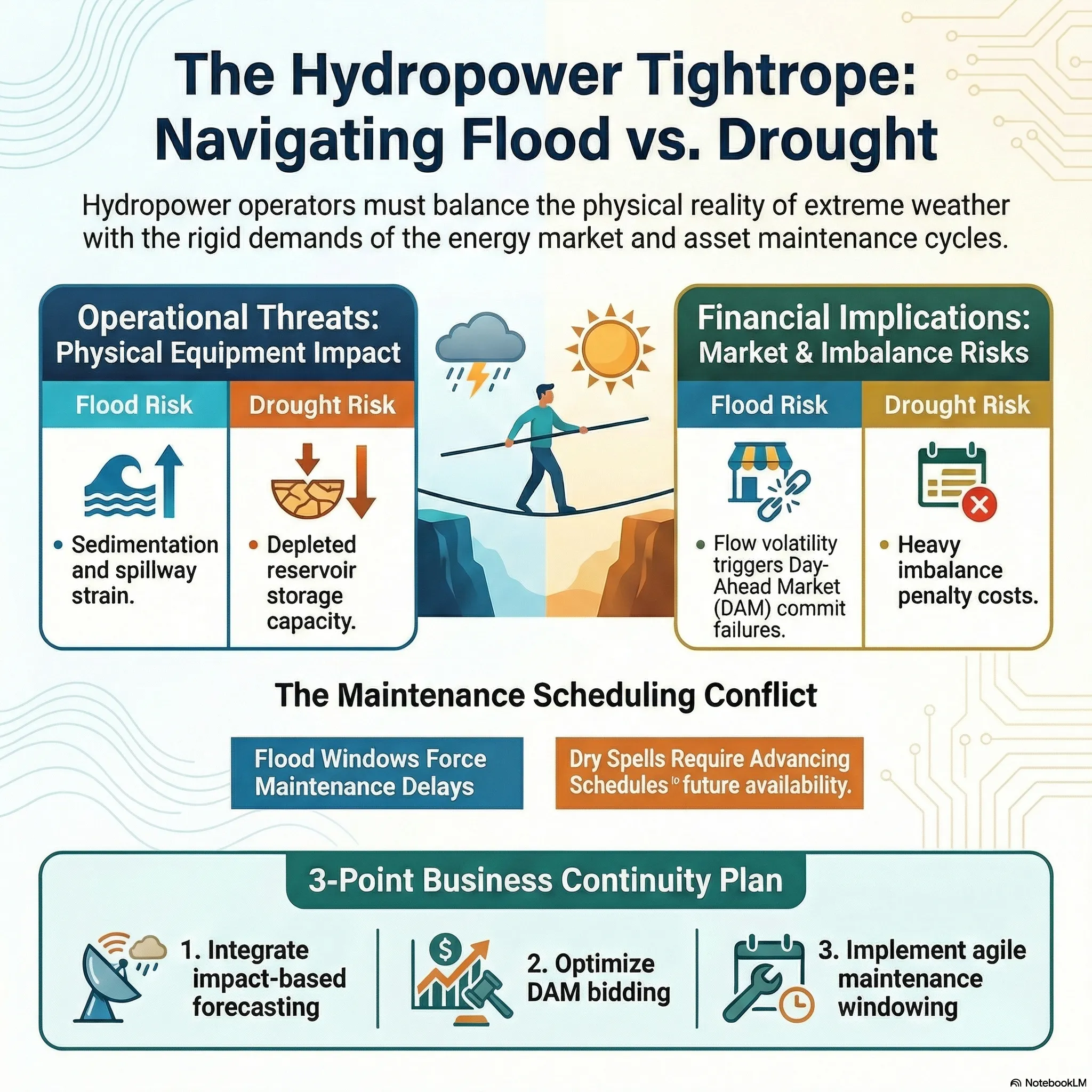
Importantly, extreme weather risk is asymmetric. Flood conditions create short-term operational stress driven by peak discharge and equipment limits. Drought conditions generate prolonged revenue compression and financial exposure. International assessments confirm that extended drought can materially reduce hydropower output at regional scale [5].
This asymmetry directly influences the production–maintenance strategy. Flood periods prioritize system protection and operational resilience. Drought periods, by contrast, may create structured maintenance windows within constrained generation cycles.
In enterprise terms, extreme weather is no longer an operational anomaly—it is a structural risk variable embedded in the hydropower business model.
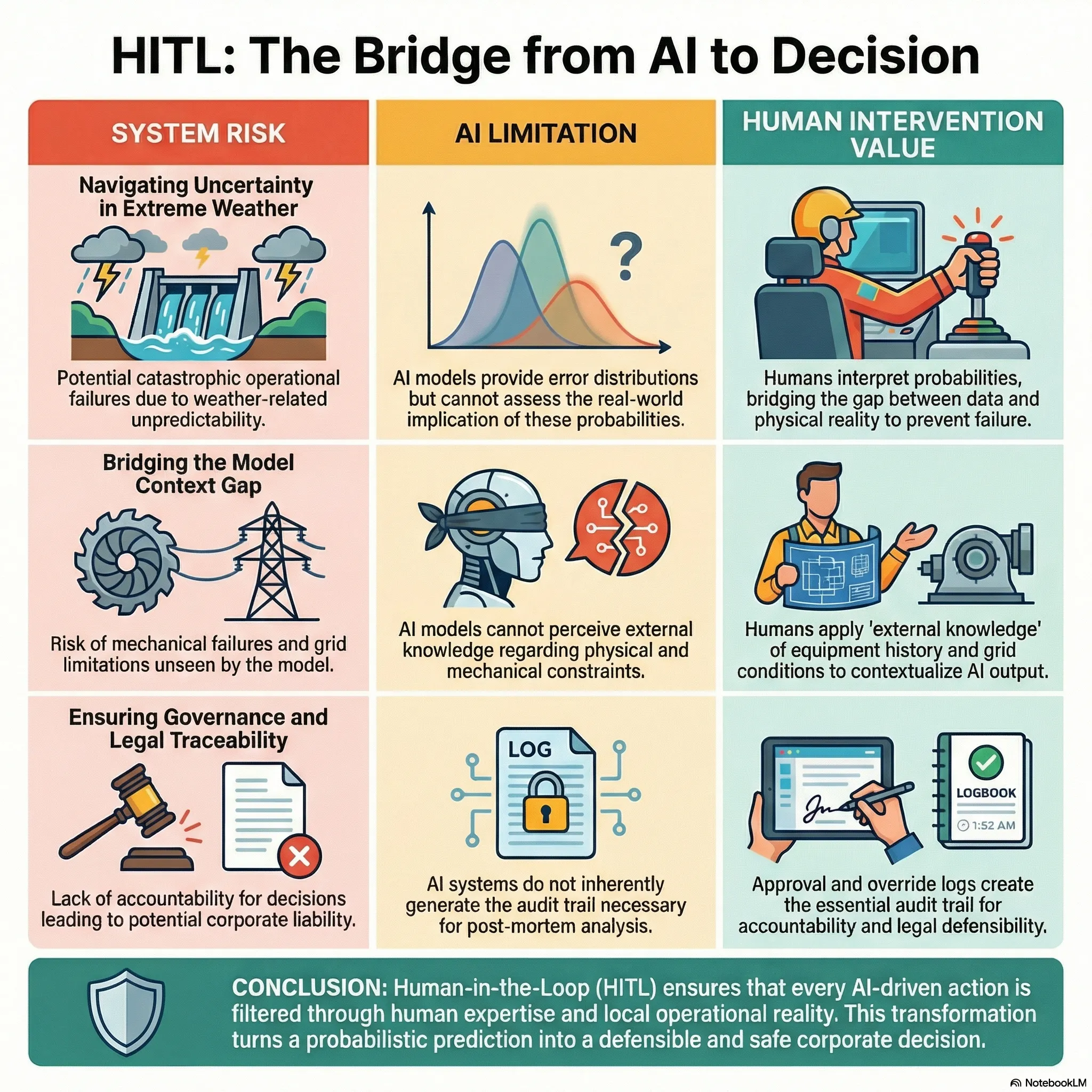
Auditable Decision Architecture: The Necessity of Human-in-the-Loop
During extreme weather events, uncertainty often becomes more decisive than model accuracy itself. Extreme conditions push the limits of training data; hydrological regime shifts and data distribution shifts (drift) occur more frequently. In such environments, even when a model’s single-point forecast appears numerically accurate, it may still be insufficient from a risk management perspective.
What enterprise decision-making requires is a structure that makes uncertainty measurable and renders the rationale behind decisions traceable.
The human-in-the-loop approach does not disable artificial intelligence; rather, it elevates AI output to an enterprise-grade decision standard. This necessity emerges across three distinct layers:
1. Operational Reality and Site-Specific Knowledge
Turbine vibration limits, spillway gate maintenance status, sediment conditions, local threshold values, and short-term maneuvering constraints are often parameters that exist primarily as field knowledge. During extreme events, these parameters become critical.
In this context, operator assessment transforms model output from a statistical projection into an actionable operational decision.
2. Auditability and Regulatory Alignment
In critical infrastructure operations, the rationale and traceability of decisions are as important as the decisions themselves. Cybersecurity and critical infrastructure governance frameworks emphasize process discipline and accountability; decision logs, responsibility mapping, and post-mortem analysis are foundational requirements [6][7].
3. Financial Risk and Commercial Risk Tolerance
The same uncertainty band may be managed differently across organizations depending on risk appetite. A trading desk may be more responsive to short-term price opportunities; operations may prioritize equipment safety; executive leadership may focus on limiting revenue volatility.
Human approval mechanisms allow these differentiated risk tolerances to be applied explicitly at the scenario level, ensuring alignment between operational integrity and commercial strategy.
Operational–Commercial Integration: AI + Operator Workflow
Enterprise extreme weather management requires a structured architecture—not isolated alerts.
The operating model must connect data → model → risk → decision → governance, with measurable KPIs at each stage.
1. Data Foundation
Integrated meteorological inputs, SWE, basin sensors, SCADA streams, and historical operations provide the analytical baseline.
Data integrity and latency are critical; under extreme conditions, minor delays can materially alter outcomes.
2. Hybrid Modeling
A combined physical hydrology model and AI correction layer ensures both process consistency and adaptive bias correction [4].
Model fusion enhances stability during regime shifts.
3. Uncertainty to Business Risk
Forecasts are scenario-based (p5 / p50 / p95), not deterministic. Hydrological uncertainty is translated into:
- Production impact (MWh)
- Revenue exposure
- Market commitment risk
This operationalizes impact-based forecasting [2].
4. Human-Governed Automation
Automation accelerates response, but accountability remains human.
Enterprise policy defines when automation proceeds, when approval is mandatory, and when dual authorization applies.
5. Governance & Continuous Learning
All decisions, overrides, and model versions are recorded.
This ensures auditability while enabling drift monitoring and performance improvement under an MLOps framework [9].
This architecture creates a unified decision layer across operations, trading, and management—transforming extreme weather from an operational disruption into a governed enterprise risk variable.
Asset Impact Analytics: Production and Maintenance Strategies Under Flood and Drought
Extreme weather impacts in hydropower plants (HPPs) extend beyond “high” or “low” discharge.
They affect equipment health, SCADA load, reservoir safety margins, environmental compliance, site accessibility, and commercial exposure. Effective production and maintenance planning must therefore respond to multidimensional risk dynamics.
1. How Do Production and Maintenance Plans Change During Flood Periods?
During floods, the primary objective becomes system safety and asset protection.
High discharge may push turbines toward hydraulic limits, while elevated sediment loads increase abrasion risk. Operational response typically follows three stages:
- Pre-event preparation: Align reservoir levels with rule curves, update discharge strategies, and confirm equipment readiness. Early warning must incorporate basin saturation and SWE—not just precipitation forecasts [4].
- Event management: Prioritize spillway operations, turbine dispatch limits, SCADA threshold control, and field safety. Planned maintenance is generally suspended to maintain system stability.
- Post-event normalization: Conduct sediment assessment, equipment inspection, and performance review to recalibrate thresholds and models for future events.
In flood scenarios, short-term production gains must not outweigh long-term asset risk.
2. How Do Production and Maintenance Plans Change During Drought Periods?
During drought, the objective shifts to economically optimized generation under water constraints.
Unlike floods, drought introduces prolonged capacity limitations and revenue pressure. Regional hydropower output can materially decline under persistent dry conditions [5], requiring closer alignment between operations and trading strategy.
Production Optimization:
Generation becomes price-responsive. Instead of uniform output, dispatch shifts toward higher-value hours while maintaining environmental flow obligations and minimum discharge limits.
Maintenance as a Strategic Window:
Constrained inflow can create an opportunity to execute planned maintenance with limited incremental production loss. However, this must remain scenario-driven; accelerating maintenance without understanding drought duration risks lost opportunity during hydrological recovery.
Floods demand protection and operational resilience. Drought demands optimization and financial discipline. Both require scenario-based planning rather than deterministic forecasting.
Example Scenario / Mini Workflow: From Risk Band to Approved Operational Plan
The following mini workflow is designed to illustrate how decision-making becomes institutionalized under uncertainty. The purpose of this scenario is not to emphasize forecast accuracy, but to make a risk-based decision framework visible in practice.
Situation: A total of 140 mm of precipitation is forecast within the basin over the next 72 hours. Snowpack is present at higher elevations, and rising temperatures are rapidly shifting precipitation from snow to rain. Soil moisture levels are already high, with AMC (Antecedent Moisture Condition) approaching saturation.Under these combined conditions, rain-on-snow dynamics can amplify peak discharge significantly [4].
Hydrowise Scenario Output (Discharge Band)
- p50 (median) peak discharge: 900 m³/s
- p95 (pessimistic scenario) peak discharge: 1,250 m³/s
- p5 (optimistic scenario) peak discharge: 750 m³/s
- Confidence score: 68% (moderate-to-high uncertainty)
Rather than presenting a single discharge value, the system provides a probabilistic band that defines operational exposure.
System-Generated Operational Recommendations:
- Lower reservoir level to the lower target band within 36 hours (pre-emptive drawdown).
- Perform spillway readiness check: gate functionality test, backup power verification, emergency operation protocol review.
- Adjust turbine dispatch: operate within a safe efficiency band instead of maximum output due to sediment risk.
- Market adjustment: revise Day-Ahead commitments; define balancing exposure limits.
- Maintenance: defer planned maintenance activities until post-event; allow only protective interventions.
Human-in-the-Loop Decision (Operator Review)
The operator incorporates site-specific conditions and defines a threshold requiring secondary approval for spillway operations. For the p95 scenario, a more conservative reservoir drawdown strategy is implemented than initially proposed by the model. This adjustment represents the explicit application of enterprise risk tolerance.
The decision record includes:
- Scenario set (p5/p50/p95)
- Model version
- Approving role
- Final action list
- Timestamp and override documentation
This ensures traceability and governance alignment.
Post-Event KPIs
- Flood risk remained below critical threshold (hydraulic safety maintained).
- Production target realized within projected risk band (commercial compliance).
- Planned maintenance deferred while protecting critical assets (asset protection).
- Model uncertainty observations fed into calibration updates for future events (MLOps feedback loop) [9].
The critical insight in this workflow is that the forecast is no longer treated as a single deterministic value. When scenario distributions are combined with operator approval, decision-making becomes measurable, traceable, and repeatable at enterprise scale.
Hydrowise / Renewasoft Approach: Hybrid Forecasting → Risk Scoring → Scenario Governance
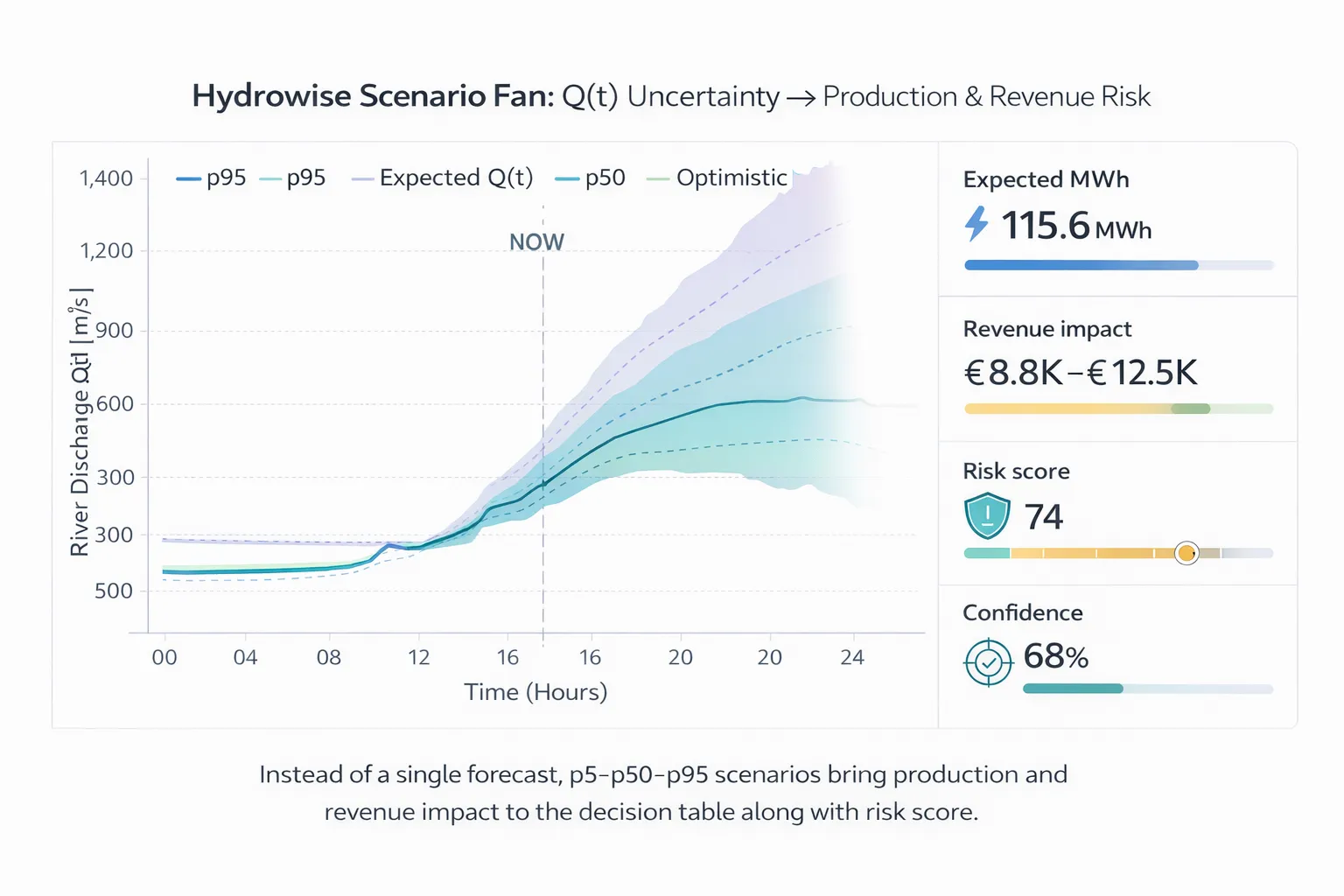
Hydrowise transforms extreme weather forecasting from a reporting function into an enterprise decision workflow. Instead of “generate forecast → publish report,” the system connects forecasting directly to operational and commercial action through four integrated layers: hybrid modeling, risk scoring, human approval workflow, and scenario-based impact translation. As illustrated above, a forecast is no longer a single curve; it becomes a structured uncertainty band explicitly linked to production, revenue, and risk exposure.
1. Hybrid Modeling: Physical + AI Integration
Hydrowise combines physical hydrological modeling with AI-based bias correction and model fusion [4]. The physical layer preserves mass balance, basin memory, and process logic, while the AI layer adapts to drift and short-term anomalies. The objective is not incremental accuracy improvement, but stability under regime shifts—particularly in non-linear conditions such as rain-on-snow events or saturated-basin precipitation.
2. Risk Scoring: Confidence + Uncertainty + Impact
Each forecast includes a scenario distribution (p5 / p50 / p95) and a confidence score. This uncertainty band is translated into expected production (MWh), revenue impact range, and market commitment exposure. Hydrological variability is therefore expressed in operational and financial terms, enabling operations to protect assets, trading to manage exposure, and leadership to monitor volatility within a shared risk framework.
3. Human Approval Workflow: Governance Embedded in Automation
In critical infrastructure environments, process discipline is foundational. Hydrowise defines confidence thresholds that can trigger mandatory manual review. Override actions are logged, and decision trails are preserved to ensure traceability and regulatory alignment [6][7]. Post-event analysis feeds structured data back into continuous model improvement within an MLOps framework [9]. The result is scalable automation without loss of accountability.
4. Scenario Modeling: Q(t) → Production → Revenue → Risk
Hydrowise extends scenario modeling beyond discharge curves. Rather than presenting p5 / p50 / p95 solely as Q(t) trajectories, the system converts them into expected production profiles, revenue impact ranges, and risk score projections. The internal discussion shifts from “Is the forecast accurate?” to “How should we manage the risk distribution?” From an enterprise perspective, the forecast ceases to be a report and becomes an operational and commercial decision instrument.
Frequently Asked Questions (FAQ)
1) Is increasing production always the right strategy during flood periods?
No. The primary objective during floods is safe operation.
Maximizing generation may conflict with spillway limits, turbine constraints, and sediment risk. When risk scores are elevated, controlled discharge and safe dispatch are preferable.
2) Does planned maintenance during drought increase production loss?
Not necessarily. Since output is already constrained, drought can create a maintenance window.
However, timing must be scenario-based and aligned with recovery probability [5].
3) What is required beyond meteorological forecasting for early warning?
An integrated framework combining meteorology, basin state, uncertainty, and operational/financial impact.
Impact-based forecasting principles support this approach [2].
4) Does human-in-the-loop slow down decision-making?
No. Properly designed workflows prevent misaligned automation under uncertainty and ensure auditability and compliance [6][7].
5) What is the operational benefit of Hydrowise’s scenario approach?
It aligns operations, trading, and management under a shared risk framework—translating discharge uncertainty into production and revenue impact.
6) How is model drift monitored during extreme events?
Through continuous monitoring of data drift, concept drift, and performance metrics within an MLOps framework [9].
7) Is this approach limited to large reservoir plants?
No. Both reservoir-based and run-of-river plants benefit from scenario-based risk management.
Conclusion
Extreme weather events have moved beyond the category of “rare crisis” and become a core operating parameter in hydropower management [1][2].
During flood periods, safe operation and asset protection must take priority. During drought periods, maximizing the economic value of limited water resources and leveraging maintenance opportunity windows becomes critical.
These opposing operational conditions cannot be managed through a single deterministic forecast. They require uncertainty-aware, scenario-driven, and human-approved enterprise workflows.
Hydrowise provides a structured framework that transforms forecasting into institutionalized decision-making:
- Hybrid modeling for robustness
- Risk scoring for measurable uncertainty
- Human-in-the-loop governance for auditability
- Scenario modeling that aligns operations and trading in a shared risk language
If you aim to make production targets, maintenance schedules, and market commitments visible within a unified risk framework during extreme weather periods, consider evaluating Hydrowise Forecast.
Schedule a Hydrowise assessment session to simulate flood and drought scenarios (p5/p50/p95) for your facility—including projected production and revenue impact—so that operations and trading teams can align around a common risk dashboard and standardized decision model.