
What Is SCADA? Which Data Are Critical in Hydropower Plants (HPPs)?
TL;DR
- SCADA is a supervisory layer that collects field data and provides centralized monitoring/control through operator interfaces. [1][2]
- In HPPs, critical data include not only electrical measurements (MW, V, A, Hz) but also process and asset-health signals (flow, head, gate/guide vane position, vibration, bearing temperature). [3][4]
- Value emerges through a chain: KPI → alarms → root-cause analysis → maintenance/operations action; raw data alone does not deliver outcomes. [5][6]
- For many modern hydro facilities, SCADA data are among the most accessible foundations for condition monitoring and predictive maintenance. [6][7]
- Operational value from SCADA data emerges only when standardization, time-series storage, KPI generation, alarm design, and analytics are structured as a unified system.
1) Concept: What exactly is SCADA?
SCADA (Supervisory Control and Data Acquisition) performs two core functions: (i) data acquisition and (ii) supervisory monitoring/control. Measurements from sensors and states/commands from actuators—typically through PLCs/RTUs—are collected by the SCADA server, while operators use HMI screens to monitor the process, receive alarms, and issue high-level commands. This architecture provides a centralized operational truth that standardizes visibility and coordination across the plant. [1][2]
In the context of power and industrial automation, SCADA is not merely displaying numbers. It often includes historian capabilities, event/alarm management, trend analysis, and operational reporting. SCADA architectures—field instrumentation, RTU/PLC layer, master station/servers, and HMI—are consistently described as a layered supervisory system supporting reliability and operations. [2]
Technical Note: SCADA vs. “control”
SCADA is typically not the primary closed-loop control system; instead, it sits above local controllers (PLCs/DCS) as a supervisory and coordination layer. Local control loops remain at the field level, while SCADA provides higher-level visibility, alarm handling, and command orchestration. [2]
2) HPP context: What does “critical data” mean?
Critical data answer: (1) Are we generating safely and efficiently right now? (2) Are we approaching a failure/outage risk soon? Accordingly, critical variables fall into three groups:
2.1 Electrical data (grid compliance and generation performance)
- Active power (kW/MW), reactive power (kVAr/MVAr)
- Voltage (V/kV), current (A)
- Frequency (Hz), power factor, harmonics (if available)
Even in micro-hydropower SCADA implementations, monitored variables commonly include voltage, current, frequency, and power. [3]
2.2 Hydraulic / process data (water → energy conversion chain)
- Flow rate (m³/s)
- Net head / pressures
- Gate/valve position, guide vane opening
- Penstock inlet/outlet pressures, valve states
- Reservoir/canal levels (depending on plant type)
Practical SCADA monitoring lists in hydropower applications include flow, guide vane opening, and pressure readings. [3]
2.3 Asset-health data (critical for predictive maintenance)
- Turbine and generator bearing temperatures, winding temperatures
- Oil temperature, oil pressure, contamination indicators (if available)
- Vibration (bearing housing, casing, shaft, etc.)
- Speed (rpm) and alignment/imbalance proxies (if available)
Vibration surveys and reviews emphasize vibration as a high-information signal tied to multiple fault mechanisms. [5] Predictive maintenance perspectives for Francis turbines highlight monitoring vibration and temperature signals. [7]
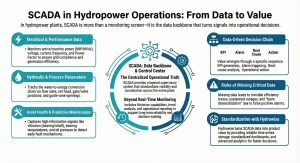
– This visual shows how SCADA systems in hydropower plants integrate electrical data, hydraulic process parameters, and asset health information to enable data-driven decision-making, risk management, and standardized operational value creation.
3) Why are these variables critical? (Business impact and risk)
3.1 Production and revenue optimization
MW, flow, and head together support efficiency reasoning and performance tracking. Modern hydropower contexts describe SCADA variables being recorded and stored for operational analysis and benchmarking. [4]
3.2 Operational safety
Positions, pressures, and temperature trends enable early detection of abnormal conditions; bearing temperature rise may indicate lubrication or alignment issues. [5][7]
3.3 Lower maintenance cost (predictive maintenance)
Reviews of predictive maintenance in SCADA-based industries argue that SCADA infrastructures can support early warning and data-driven maintenance. [6] Hydropower diagnostics work frames a practical pipeline from data acquisition to diagnosis. [8]
Risk Box: Typical consequences when critical data are missing
- Failures remain invisible until they are felt → more unplanned outages. [5][8]
- Arbitrary thresholds → false positives/negatives desensitize teams. [8]
- Efficiency losses persist unnoticed. [4]
4) Example scenario: What should an operator see on SCADA?
Scenario: Vibration increase + bearing temperature rise
- A trend shows a gradual rise in turbine bearing temperature. [3][5]
- Vibration RMS exceeds the normal band. [5][7]
- Flow and MW are stable, so load variation is unlikely.
- The operator escalates alarm severity and notifies maintenance.
- Maintenance checks misalignment, lubrication, bearing condition, etc. [5]
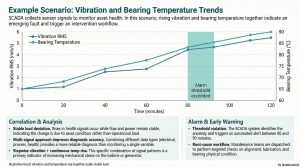
Multi-variable interpretation strengthens diagnosis; condition monitoring literature emphasizes multi-signal approaches in hydropower. [8]
5) From SCADA Data to Operational Value
Raw SCADA data does not create value on its own. Value emerges when data is structured and connected to operational workflows.
A typical transformation chain includes:
• Data standardization (tag, unit, timestamp consistency)
• Time-series storage for historical analysis
• KPI derivation (efficiency, performance trends)
• Alarm and anomaly detection
• Root-cause analysis and decision workflows
This transformation turns SCADA from a monitoring system into a decision-support system.
Info Card: Minimum critical dataset for HPPs (starter package)
- Electrical: MW, V, A, Hz, reactive power
- Process: flow, net head/pressure, gate/guide vane opening
- Health: bearing temperatures, oil temperature, vibration
- Events: alarm/fault codes, start/stop events, operating mode
6) FAQ
1) Are SCADA and DCS the same? No. SCADA is supervisory; PLC/DCS executes local control loops. [2]
2) What is the single most critical variable? Avoid single-variable thinking; interpret MW/flow with vibration/temperature trends. [3][5][7]
3) How to set alarm thresholds? Include trends and operating modes; fixed thresholds alone are often insufficient. [8]
4) Is SCADA data sufficient for predictive maintenance? Often a strong starting point. [6][8]
5) Why is retention important? Root-cause and performance analysis require historical trends. [4]
7) Conclusion and Next Steps
SCADA in hydropower is a data backbone. Critical variables span electrical, process, and asset-health dimensions. Next steps: (1) extract tag lists, (2) define critical dataset & KPIs, (3) document alarm design, (4) plan standardization + time-series storage + alarm/analytics layers together.
If you would like to learn more about securing critical energy infrastructure and improving OT cybersecurity practices, feel free to contact us:
References
[1] Role of SCADA in Hydro Power Plant Automation. (2015). ResearchGate publication. (Accessed: 2026-02-21).
[2] He, W., et al. (2024). An Open-Source Supervisory Control and Data Acquisition (SCADA) … Energies.
[3] Kart, T. A. (2025). Micro-Hydroelectric Power Plant SCADA monitoring… Düzce University Journal of Science & Technology.
[4] Doujak, E., et al. (2023). Fatigue Strength Analysis of a Prototype Francis Turbine… Energies.
[5] Mohanta, R. K., et al. (2017). Sources of vibration and their treatment in hydro power stations… Journal of Rock Mechanics and Geotechnical Engineering.
[6] Predictive Maintenance in SCADA-Based Industries: A literature review. (2021). ResearchGate PDF.
[7] A review of condition monitoring in Francis turbines for predictive maintenance. (2025). ResearchGate publication.
[8] Selak, L., et al. (2014). Condition monitoring and fault diagnostics for hydropower plants (HPP)… Computers in Industry.
[9] Holder, G. (2025). Defining Digitalization Barriers for HPP Refurbishment (STSM report).